"...when the last individual
of a race of living things breathes no more, another Heaven and another
Earth must pass before such a one can be again."
-William Beebe
 • SEARCH ALBC
Colonial Spanish Horse
 The
Colonial Spanish horse is a group of closely related breeds that descend
from horses brought by Spanish explorers and colonists to the Americas
beginning in the 1500s. Horses were an integral part of Spanish success
in the New World, and both domestic and feral stocks spread far and wide.
For centuries, Spanish horses were the most common type of horse throughout
the Southeast and all of the regions west of the Mississippi. Beginning
in the mid- to late 1800s, however, almost all Spanish stocks were crossbred
with or replaced by horses of larger size, including Thoroughbreds, other
riding horse breeds, and draft horses. Ubiquitous in 1750 and 1850, the
pure Spanish horse in North America was almost extinct by 1950.
The
Colonial Spanish horse is a group of closely related breeds that descend
from horses brought by Spanish explorers and colonists to the Americas
beginning in the 1500s. Horses were an integral part of Spanish success
in the New World, and both domestic and feral stocks spread far and wide.
For centuries, Spanish horses were the most common type of horse throughout
the Southeast and all of the regions west of the Mississippi. Beginning
in the mid- to late 1800s, however, almost all Spanish stocks were crossbred
with or replaced by horses of larger size, including Thoroughbreds, other
riding horse breeds, and draft horses. Ubiquitous in 1750 and 1850, the
pure Spanish horse in North America was almost extinct by 1950.
A few herds of pure Spanish horses remained in the Southeast and the Southwest, owned by traditional ranchers or Native American tribes, and a few were found in isolated feral herds. From these remnants, conservation programs began. Several groups of people have been involved. First among these has been the Spanish Mustang Registry, founded in 1957, followed by the American Indian Horse Registry, the Spanish Barb Breeders Association, and the Southwest Spanish Mustang Association. Today, these associations register more than 200 horses per year, and the breed population numbers over 2,000.
 The
North American Spanish horse population includes many distinct strains,
and these could be considered either parts of a larger, single breed,
or several smaller, closely related breeds. Given the overall consistency
of this population and the fact that many individual horses are registered
in more than one of the registries, the American Livestock Breeds Conservancy
has chosen to consider them as one breed.
The
North American Spanish horse population includes many distinct strains,
and these could be considered either parts of a larger, single breed,
or several smaller, closely related breeds. Given the overall consistency
of this population and the fact that many individual horses are registered
in more than one of the registries, the American Livestock Breeds Conservancy
has chosen to consider them as one breed.
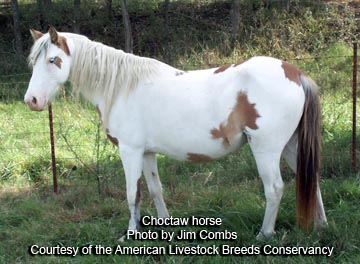
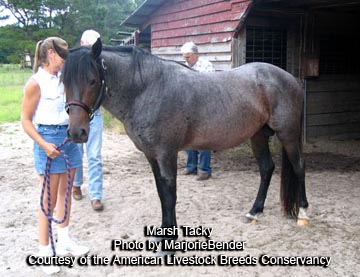
The Colonial Spanish horse goes by a number of names including Spanish Mustang, Spanish Barb, or their strain name. Regardless of the name, they share conformational features that distinguish them from other riding breeds. They are small, standing 13.2 to 15 hands (54-60") at the withers and weighing 700-900 pounds. The horses are generally short coupled and deep bodied, but narrow from the front so that the front legs join the chest in the shape of an "A" rather than the shape of a "U" that is seen in the stock horse breeds. The croup is sloping and the tail is set low. The horses have broad foreheads and narrow faces, and the profiles may be either straight or convex. Spanish horses are athletic and useful for a variety of riding disciplines, among them ranch work, endurance competitions, and pleasure riding. They have an unusually long stride, and many of them are gaited. They are renown for their even temperament and gentle dispositions.
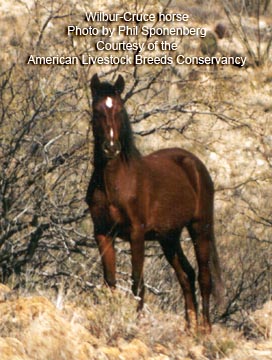 Nearly
all colors of horses occur in this breed. Solid colors include black,
grullo, bay, dun, buckskin, chestnut, red dun, palomino, and cream. Gray
and roan are common, as are every sort of paint (frame, sabino, and tobiano)
and the leopard complex of colors commonly associated with the Appaloosa
breed (including blankets, leopards, and varnish roans). Indeed, Spanish
genetics are the source of the color in the Paint, Pinto, Appaloosa, Pony
of the Americas, Palomino, and other breeds. The Spanish horse has also
made substantial contributions to the American gaited breeds and to the
American Quarter Horse and other stock horse breeds.
Nearly
all colors of horses occur in this breed. Solid colors include black,
grullo, bay, dun, buckskin, chestnut, red dun, palomino, and cream. Gray
and roan are common, as are every sort of paint (frame, sabino, and tobiano)
and the leopard complex of colors commonly associated with the Appaloosa
breed (including blankets, leopards, and varnish roans). Indeed, Spanish
genetics are the source of the color in the Paint, Pinto, Appaloosa, Pony
of the Americas, Palomino, and other breeds. The Spanish horse has also
made substantial contributions to the American gaited breeds and to the
American Quarter Horse and other stock horse breeds.
Status: See CPL
Click Here for Breed Clubs and Association Contacts
| The American Livestock Breeds Conservancy | |
PO Box 477 |
ALBC is a trademark
of American Livestock Breeds Conservancy. |
Pittsboro, North Carolina 27312 USA |
|
Telephone: 919-542-5704 |
|
Fax: 919-545-0022 |
|
|
HOME About
ALBC Breed Information Calendar ALBC
Store |
|