"...when the last individual
of a race of living things breathes no more, another Heaven and another
Earth must pass before such a one can be again."
-William Beebe
 • SEARCH ALBC
Cubalaya Chicken
 The
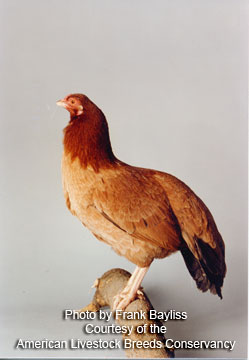
Cubalaya is a beautiful multi-purpose chicken first developed in Cuba
prior to its US introduction in 1939. The pea-combed breed combines the
traits of the Oriental game fowl brought to Cuba from the Philippines
with the more ornately feathered game fowl of Europe – creating
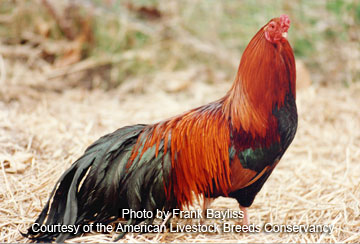
an elegant-looking chicken. The primary breed characteristic is the unique
“lobster tail.” This attribute features a downward-angling
tail with lavish feathering making these birds difficult to confuse with
any other breed of chicken. Cubalayas come in many different colors. The
most commonly seen are black-breasted red cocks with wheaten hens (wheaten
Cubalayas are a darker "cinnamon" shade of wheaten which usually
lightens with age) and both cocks and hens solid black. There have been
a few whites, and the most favored traditional color in Cuba seems to
have been the blue-red wheaten, which they refer to as "ashen"
(cenizo). A distinctive trait of the Cubalaya is a lack of spurs, which
was favored during the breed’s development. This lack of spurs prevents
young males from injuring one another during struggles for dominance.
The
Cubalaya is a beautiful multi-purpose chicken first developed in Cuba
prior to its US introduction in 1939. The pea-combed breed combines the
traits of the Oriental game fowl brought to Cuba from the Philippines
with the more ornately feathered game fowl of Europe – creating
an elegant-looking chicken. The primary breed characteristic is the unique
“lobster tail.” This attribute features a downward-angling
tail with lavish feathering making these birds difficult to confuse with
any other breed of chicken. Cubalayas come in many different colors. The
most commonly seen are black-breasted red cocks with wheaten hens (wheaten
Cubalayas are a darker "cinnamon" shade of wheaten which usually
lightens with age) and both cocks and hens solid black. There have been
a few whites, and the most favored traditional color in Cuba seems to
have been the blue-red wheaten, which they refer to as "ashen"
(cenizo). A distinctive trait of the Cubalaya is a lack of spurs, which
was favored during the breed’s development. This lack of spurs prevents
young males from injuring one another during struggles for dominance.
 Cubalayas
are known as producers of quality meat and can often be very reliable
layers of tinted eggs. They are medium-sized birds with cocks weighing
six pounds and hens weighing four pounds at maturity. This breed is slow
to mature taking up to three years to reach adulthood, although they are
capable of reproducing beginning at six – seven months of age. Adult roosters
grow to 6 pounds at maturity and hens will reach 4 pounds. These birds
do well when raised on grass and actively enjoy foraging for insects.
Cubalayas
are known as producers of quality meat and can often be very reliable
layers of tinted eggs. They are medium-sized birds with cocks weighing
six pounds and hens weighing four pounds at maturity. This breed is slow
to mature taking up to three years to reach adulthood, although they are
capable of reproducing beginning at six – seven months of age. Adult roosters
grow to 6 pounds at maturity and hens will reach 4 pounds. These birds
do well when raised on grass and actively enjoy foraging for insects.
The trait most favored in this breed is their tameness. Many of the chicks are friendly from the day they’re hatched and will eat out of the owner’s hand even with no previous handling. These birds have a generally brave disposition and, as chicks, may not fear predators unless caution is learned from their parents or other experienced birds.
Status: See CPL
| The American Livestock Breeds Conservancy | |
PO Box 477 |
ALBC is a trademark
of American Livestock Breeds Conservancy. |
Pittsboro, North Carolina 27312 USA |
|
Telephone: 919-542-5704 |
|
Fax: 919-545-0022 |
|
|
HOME About
ALBC Breed Information Calendar ALBC
Store |
|