"...when the last individual
of a race of living things breathes no more, another Heaven and another
Earth must pass before such a one can be again."
-William Beebe
 • SEARCH ALBC
Dominique Chicken
The Dominique chicken is recognized as America’s first chicken breed. The exact origin of the breed is unknown, 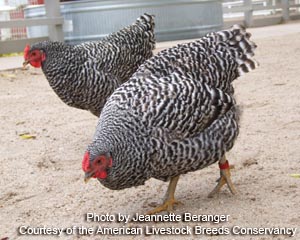 although their initial creation may have involved European chicken breeds and later in its refinement, some Asian varieties. The name of “Dominique” may have come from birds that were imported from the French colony of Saint-Domingue (today known as Haiti) and which are thought to have been used as part of the development of the Dominique breed.
Barred chickens with both rose combs and single combs were somewhat common in the eastern United States as early as 1750. As interest in poultry breeding increased, attention was given to develop uniformity in chicken breeds. Early names of these fowl include Blue Spotted Hen, Old Grey Hen, Dominico, Dominic, and Dominicker. The breed was widely known on the eastern coast of the U.S. as the Dominique.
The Dominique was plentifully bred on American farms as early as the 1820’s, where these birds were a popular dual-purpose fowl. In 1871 the New York Poultry Society decided that only the rose combed Dominique would become the standard for the breed and the single combed Dominiques were relegated to and folded into the Plymouth Rock breed – popular in New England, created by crossing large, single comb Dominiques with Java chickens. Dominiques were never used commercially, and the breed was eventually eclipsed on the farm by the gradual shift to the larger “Plymouth Rocks.” In 1874 the Dominique breed was officially admitted to the American Poultry Association’s Standard of Perfection.
The Dominique enjoyed popularity until the 1920’s at which time interest in the breed waned due to the passing of aged, long-time Dominique enthusiasts and breeders. The breed managed to survive during the Great Depression of the 1930’s due to its hardiness and ease of up-keep. By the end of World War II as industrial poultry operations began to take a foothold in the U.S., the Dominique once again experienced decline. By 1970 only 4 known flocks remained, held by: Henry Miller, Edward Uber, Robert Henderson, and Carl Gallaher. Through the effort of dedicated individuals the remaining owners were contacted and convinced to participate in a breed rescue. From 1983, following published reports on the breed by ALBC, until 2006, Dominiques steadily rose in numbers. As of 2007, it has been observed by the breed’s enthusiasts that numbers are once again beginning to decline, as old time breeders of Dominique age and are no longer involved with keeping and promoting the breed.
The Dominique is a medium-sized black and white barred (otherwise known as “cuckoo” patterned) bird. The barred plumage coloration is also referred to as hawk-colored and serves the Dominique in making the bird less conspicuous to predators. The Dominique sports a rose comb with a short upward curving spike that is characteristic to this breed. The males average seven pounds and the females five pounds. The Dominique’s tightly arranged plumage, combined with the low profile of the rose comb, make this breed more resistant to frostbite than many other breeds of fowl. Dominiques are also known to adapt well to hot and humid climates. Historically the close feathering of this breed not only protected the birds in cold weather, but provided ample material for the pillows and featherbeds of their owners.
Dominiques carry their heads high up on well-arched necks. The males of the breed have an almost “u” shaped back outline. Their body is broad and full with long and full tail feathers that are held the highest of the American breeds. Females have back outlines that slope from head to tail.
Although categorized as a dual-purpose breed, these birds are first and foremost egg producers with hens historically averaging 230-275 small- to medium-sized brown eggs.
Status: See CPL
| The American Livestock Breeds Conservancy | |
PO Box 477 |
ALBC is a trademark
of American Livestock Breeds Conservancy. |
Pittsboro, North Carolina 27312 USA |
|
Telephone: 919-542-5704 |
|
Fax: 919-545-0022 |
|
|
HOME About
ALBC Breed Information Calendar ALBC
Store |
|