"...when the last individual
of a race of living things breathes no more, another Heaven and another
Earth must pass before such a one can be again."
-William Beebe
 • SEARCH ALBC
Java Chicken
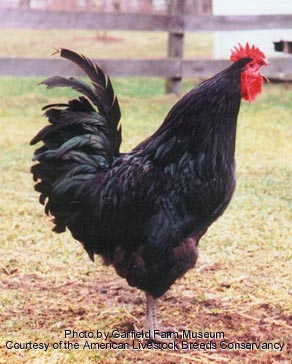
The Java is considered the second oldest breed of chicken developed in America. Its ancestors were reputed to have come from the Far East, possibly from the isle of Java. Sources differ on the time of origin of the Java, but the breed was known to be in existence in America sometime between 1835 and 1850. They did not reach Britain until 1885, and this is important as those that claim they originated in pure form directly from the island of Java cite England as their source of stock (from Java by way of England). It is possible 1835 may even be late in the development of this breed.
The Java is a premiere homesteading fowl, having the ability to do well when given free range. While slower in rate of growth compared to some more modern breeds, the Java was noted for the production of meat during the mid 1800s. The Plymouth Rock and Jersey Giant breeds owe much to the Java, as the Java was used in the creation of both of these breeds which later supplanted it.
Javas come in four varieties: Black, Mottled, White, and Auburn. The Black Java is noted for the beetle-green sheen of its feathers, a green sheen more brilliant than any other black fowl except the Langshan (speaking in terms of English and American experiences). The Blacks further have very dark eye color, being dark brown or even nearly black. Black Javas have black legs with yellow soles on their feet. Mottled Javas should have very intense red eye color, and their feathering is black with splashes, or mottles, of white. The legs of the Mottled Java should be a broken leaden-blue with yellow soles. The White Java was admitted to the American Poultry Association Standard of Perfection, but was removed prior to 1910 as it was felt that it and the White Plymouth Rock were too similar. White Javas have yellow leg color. The Auburn Java has never been recognized by the APA, but is mentioned as a color sport of the Black Java in writings as early as 1879, and it is most noted for its use in the development of the Rhode Island Red chicken breed. All Javas have yellow skin and lay brown eggs. Although the APA only recognizes the Black and the Mottled Java colors in its Standard of Perfection the White and the Auburn are being actively bred by a core of dedicated producers interested in bringing these colors back to the breed.
The body type is one of the most distinguishing features of Javas. They have a rectangular shape, much like the Rhode Island Red, but with a sloping back line. The back should be long; in fact Javas have the longest backs in the American Class. Javas have full, well-rounded breasts. Originally this breed, like the Buckeye and the Rhode Island, had tight feathers.
Another distinguishing feature is that the single comb on all Javas should not show a point too far forward on the comb (the first point should be above the eye, not above the nostril). While this last characteristic is of no economic value, it may be of value in terms of identifying purity of the stock. It also indicates a single combed bird that was produced from pea-combed ancestors.
Status: See CPL
| The American Livestock Breeds Conservancy | |
PO Box 477 |
ALBC is a trademark
of American Livestock Breeds Conservancy. |
Pittsboro, North Carolina 27312 USA |
|
Telephone: 919-542-5704 |
|
Fax: 919-545-0022 |
|
|
HOME About
ALBC Breed Information Calendar ALBC
Store |
|