"...when the last individual
of a race of living things breathes no more, another Heaven and another
Earth must pass before such a one can be again."
-William Beebe
 • SEARCH ALBC
Suffolk Horse
 The
Suffolk is the only draft horse breed developed and selected exclusively
for farm work. The breed originated in Suffolk and Norfolk in -eastern
England, where horses of draft type date back to the 1500s. The Suffolk
Horse -Society was founded in 1877, and the first volume of the -Suffolk
studbook was published in 1880. All horses in the studbook trace their
male lines back to the foundation stallion Crisp’s Horse of Ufford,
foaled in 1768.
The
Suffolk is the only draft horse breed developed and selected exclusively
for farm work. The breed originated in Suffolk and Norfolk in -eastern
England, where horses of draft type date back to the 1500s. The Suffolk
Horse -Society was founded in 1877, and the first volume of the -Suffolk
studbook was published in 1880. All horses in the studbook trace their
male lines back to the foundation stallion Crisp’s Horse of Ufford,
foaled in 1768.
Suffolk and Norfolk are bordered on the north, east, and south by the North Sea, and on the west by the fens (or marshes). The region is so isolated, and the Suffolk horse was considered so valuable that it was bred pure and changed little over the past three hundred years. The -Suffolk is unusual among draft breeds in that it was never selected for anything other than agricultural work. As a result, the breed retains characteristics relevant to this enterprise, such as the strength and stamina to plow through heavy clay, hardiness, a willing disposition, and easy-keeping qualities.
Suffolk horses were first imported to Canada in 1865 and to the United States in 1880. The Suffolk had strongholds in the Midwest, New England, and Ontario, though it was never as popular as the Percheron, Belgian, or Clydesdale. The breed declined in numbers after World War II and came close to global extinction in the 1950s. It was only through the efforts of a few breeders that the Suffolk survived. Today there are about 600 Suffolk horses in the United States and about 200 in England. The breed is still rare, but its numbers are increasing. The Suffolk’s moderate size compared to that of the other draft breeds has been an asset in its promotion to those who continue to farm with horses.
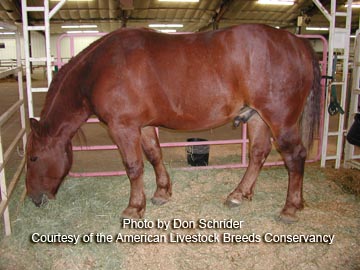
The Suffolk breed is consistent and distinctive in appearance. All Suffolks are chestnut in color, one of seven shades between gold and liver. White markings are rarely seen. The horses stand 16-17 hands (64-68”) at the withers and average 1,800 pounds. The legs are short, clean, and well-muscled, with dense bone. The shoulders are inclined to be upright, suitable more for power than for action. The back is short and strong, and the hindquarters are long and smooth. The breed’s nickname “Suffolk Punch” refers to the horses’ rounded appearance.
The beauty of the Suffolk is summed up by the writer Marguerite Henry
in her classic Album of Horses: “His color is bright chestnut, like
a tongue of fire against the black field furrows, against green corn blades,
against yellow wheat, against blue horizons.” Today’s -Suffolk
horses reflect not only the breed’s history but also the long -tradition
of farming with horses. They are a living treasure.
Status: See CPL
Click Here for Breed Clubs and Association Contacts
| The American Livestock Breeds Conservancy | |
PO Box 477 |
ALBC is a trademark
of American Livestock Breeds Conservancy. |
Pittsboro, North Carolina 27312 USA |
|
Telephone: 919-542-5704 |
|
Fax: 919-545-0022 |
|
|
HOME About
ALBC Breed Information Calendar ALBC
Store |
|