"...when the last individual
of a race of living things breathes no more, another Heaven and another
Earth must pass before such a one can be again."
-William Beebe
 • SEARCH ALBC
Pomeranian Goose
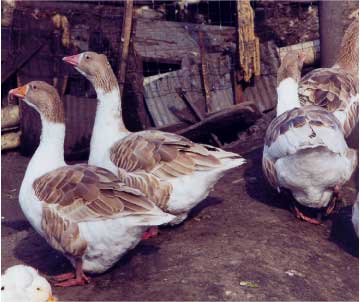 Pomeranian
geese average 15-17 pounds and lay 15-35 eggs annually. Northern German
farmers developed the Pomeranian goose. Literature references date its
origins to as early as 1550. The Pomeranian is the only descendent of
the European Greylag specifically bred for a single-lobed paunch (Ashton,
1999). In North America, however, Pomeranian geese often exhibit two lobes
due to crossbreeding and genetic variations.
Pomeranian
geese average 15-17 pounds and lay 15-35 eggs annually. Northern German
farmers developed the Pomeranian goose. Literature references date its
origins to as early as 1550. The Pomeranian is the only descendent of
the European Greylag specifically bred for a single-lobed paunch (Ashton,
1999). In North America, however, Pomeranian geese often exhibit two lobes
due to crossbreeding and genetic variations.
In their native Germany, the term Pomeranian refers to a utilitarian goose breed. German Pomeranians are colored white, gray, saddleback buff, or saddleback gray. Only the Saddleback Pomeranian exists in North America. The head, back, and flanks of a saddleback are either buff or gray. All colored feathers of the back and flank are edged in near-white. The rest of the bird is white. A Pomeranian should have a pinkish red bill, reddish orange legs, and blue eyes (Holderread, 1981).
In addition to the distinctive single lobe, Pomeranian geese have slightly flattened heads. This, in combination with their stout necks, protruding breasts, and rounded bodies, gives them the appearance some breeders describe as “arrogant” (Ashton, 1999; Batty, 1985).
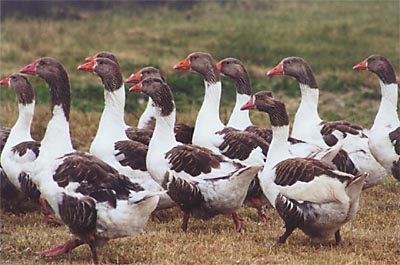 While
some Pomeranians are docile and pleasant to show, others are quick to
read nervous body language and respond aggressively. Pomeranians tend
to greet visitors noisily so make good watch birds (Ashton, 1999).
While
some Pomeranians are docile and pleasant to show, others are quick to
read nervous body language and respond aggressively. Pomeranians tend
to greet visitors noisily so make good watch birds (Ashton, 1999).
When selecting breeders, look for birds with chunky bodies and well-defined markings. When viewed from behind and above, the colored areas of the backs and shoulders should be reminiscent of the classic heart shape. Solid-colored heads are preferred, but most specimens have white feathers around the base of their bills. Some strains of Pomeranians produce birds with slight indications of knobs at the base of their bills. Guard against this fault since it is evidence of crossbreeding. Also, avoid breeding from specimens with dewlaps, orange bills and feet, excessively white heads, dark feathers in the wings, and undersized bodies (Holderread, 1981).
Pomeranians are a good all-around breed for a colorful home flock. While the plumage markings are fairly fixed genetically, producing a properly marked specimen is a challenge. Ganders can be mated with three to four geese.
Status: See CPL
Bibliography:
Ashton, Chris. 1999. Domestic Geese.
The Crowned Press, LTD. Ramsbury, England.
Batty, J. 1985. Domesticated Ducks and Geese. Nimrod Book Services. Liss, England.
Bender, Marjorie; Sponenberg, D. Phillip; Bixby, Donald. 2000. Taking Stock of Waterfowl: The results of the American Livestock Breeds Conservancy’s Domestic Duck and Goose Census. American Livestock Breeds Conservancy. Pittsboro, North Carolina.
Holderread, Dave. 1981. The Book of Geese: a Complete Guide to Raising the Home Flock. Hen House Publications. Corvallis, Oregon
Malone, Pat; Donnelly, Gerald; Leonard, Walt. 1998. American Standard of Perfection. American Poultry Association, Inc. Mendon, Massachusetts.
Click Here for Breed Clubs and Association Contacts
| The American Livestock Breeds Conservancy | |
PO Box 477 |
ALBC is a trademark
of American Livestock Breeds Conservancy. |
Pittsboro, North Carolina 27312 USA |
|
Telephone: 919-542-5704 |
|
Fax: 919-545-0022 |
|
|
HOME About
ALBC Breed Information Calendar ALBC
Store |
|