"...when the last individual
of a race of living things breathes no more, another Heaven and another
Earth must pass before such a one can be again."
-William Beebe
 • SEARCH ALBC
Roman Goose
 The
Roman goose originated in Italy. More than 2000 years ago, Romans considered
these geese sacred to Juno (the goddess of marriage) (Batty, 1979). In
365 BC, as the Gauls attempted to steal into Rome past sleeping guard
dogs under cover of night, it was the honk of a Roman goose that awoke
Marcus Manlius and saved the capitol (Ashton, 1999). The Roman goose is
a small (10-12 lb), moderate egg-laying (25-35 per year) ornamental goose.
In Europe, Roman geese are utility birds, bred for a rapid maturing, small,
meaty carcass. In North America, they are ornamental-bred for a distinguishing
crest, or tuft. In common North American usage, which is followed here,
“Roman” goose is used interchangeably with “Tufted Roman” goose.
The
Roman goose originated in Italy. More than 2000 years ago, Romans considered
these geese sacred to Juno (the goddess of marriage) (Batty, 1979). In
365 BC, as the Gauls attempted to steal into Rome past sleeping guard
dogs under cover of night, it was the honk of a Roman goose that awoke
Marcus Manlius and saved the capitol (Ashton, 1999). The Roman goose is
a small (10-12 lb), moderate egg-laying (25-35 per year) ornamental goose.
In Europe, Roman geese are utility birds, bred for a rapid maturing, small,
meaty carcass. In North America, they are ornamental-bred for a distinguishing
crest, or tuft. In common North American usage, which is followed here,
“Roman” goose is used interchangeably with “Tufted Roman” goose.
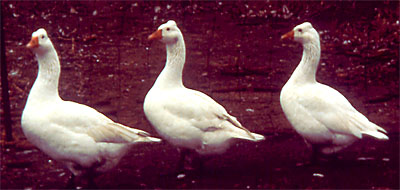
Roman geese ought be pure white, according to the American Standard of Perfection. Some strains have gray or buff feathers. Goslings may show some gray but this is often molted in the first year. Bills and legs are pinkish or reddish orange, and the eyes are blue (Malone, et. al., 1998; Holderead, 1983).
The Roman goose is fine-boned and plump. The body is round and full, with a uniformly broad back. The breast is keelless. The abdomen is rounded and full with dual lobes, though without a heavy paunch. The tail is short, and wings strong. The neck is of medium length, stout, and only slightly arched. The head is oval. The tuft of feathers on their crown, for which they are named, begins just over the eyes and inclines backward (Malone et al., 1998). The tuft appears somewhat like a tiny bicycle helmet perched on top the goose head.
Roman geese in North America descend from a small group of birds, resulting in a small genetic pool. As a result, special care must be taken when selecting breeders to avoid genetic defects, including crooked toes, wry tails, kinked necks, and lack of vigor. Look for calm, gentle, robust birds with small, compact bodies, and large tufts centrally placed on the head. The front edge of the tuft should be over the back of the eyes. Ganders can be mated with two to four geese. (Holderread, 1983).
Roman geese are generally calm and pleasant. Despite their small size, Roman geese produce a plump roasting bird. (Holderread, 1983).
Status: See CPL
Bibliography:
Ashton, Chris. 1999. Domestic Geese.
WBC Book Manufacturers Ltd. Mid Glamorgan: England. 29-32.
Batty, J. 1979. Domesticated Ducks and Geese. Nimrod Book Services. Liss, Hants: England. 191-194.
Bender, Marjorie; Sponenberg, D. Phillip; Bixby, Donald. 2000. Taking Stock of Waterfowl: The results of the American Livestock Breeds Conservancy’s Domestic Duck and Goose Census. American Livestock Breeds Conservancy. Pittsboro, North Carolina.
Holderread, Dave. 1981. The Book of Geese: a Complete Guide to Raising the Home Flock. Hen House Publications. Corvallis, Oregon.
Malone, Pat; Donnelly, Gerald; Leonard, Walt. 1998. American Standard of Perfection. American Poultry Association, Inc. Mendon, MA.
| The American Livestock Breeds Conservancy | |
PO Box 477 |
ALBC is a trademark
of American Livestock Breeds Conservancy. |
Pittsboro, North Carolina 27312 USA |
|
Telephone: 919-542-5704 |
|
Fax: 919-545-0022 |
|
|
HOME About
ALBC Breed Information Calendar ALBC
Store |
|