"...when the last individual
of a race of living things breathes no more, another Heaven and another
Earth must pass before such a one can be again."
-William Beebe
 • SEARCH ALBC
Shetland Goose
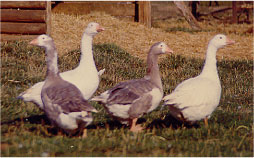 Shetland geese average 12-14 lbs, and lay about 30 eggs yearly. Shetland
geese are noted for their foraging ability and sex-linked color. Their
coloration sometimes leads to confusion with Pilgrim geese, which are
also color sex-linked. The plumage of the gander is white, and his eyes
are blue. The goose (female) is half white and half gray. The shoulders,
secondary flight feathers, under-wing back and thigh coverts are gray.
The head and neck are mainly white, with varying amounts of gray plumage
on the lower neck. The eyes of a goose are brown or brown and blue mottled.
The bill of both sexes is orange and reddens towards the nostrils.
Shetland geese average 12-14 lbs, and lay about 30 eggs yearly. Shetland
geese are noted for their foraging ability and sex-linked color. Their
coloration sometimes leads to confusion with Pilgrim geese, which are
also color sex-linked. The plumage of the gander is white, and his eyes
are blue. The goose (female) is half white and half gray. The shoulders,
secondary flight feathers, under-wing back and thigh coverts are gray.
The head and neck are mainly white, with varying amounts of gray plumage
on the lower neck. The eyes of a goose are brown or brown and blue mottled.
The bill of both sexes is orange and reddens towards the nostrils.
The Shetland goose (both sexes) has a broad back and a well rounded, keelless breast. The paunch is single-lobed. The wings are powerful, allowing full ability of flight.
 When
selecting breeders choose vigorous, strong-legged birds free of physical
deformities. Consider growth rate, egg production, and forage ability
for utility birds. Due to the rarity of these birds, please consult the
American Livestock Breeds Conservancy to develop a breeding program.
When
selecting breeders choose vigorous, strong-legged birds free of physical
deformities. Consider growth rate, egg production, and forage ability
for utility birds. Due to the rarity of these birds, please consult the
American Livestock Breeds Conservancy to develop a breeding program.
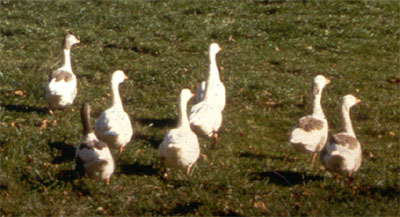
The Shetland Goose combines several valuable traits including a shortened bill for active foraging. With ample access to succulent grasses, Shetland geese will forage for most of their food.
Shetland geese typically mate for life. Females often go broody after laying approximately18 eggs, and are successful setters and mothers.
A conservation study is underway because of concern that the genetic base for the breed in the United States may be too narrow to sustain. Additional imports are needed to provide a more secure genetic base.
Status: See CPL
Bibliography:
Bender, Marjorie; Sponenberg, D. Phillip;
Bixby, Donald. 2000. Taking Stock of Waterfowl: The results of the
American Livestock Breeds Conservancy’s Domestic Duck and Goose Census.
American Livestock Breeds Conservancy. Pittsboro, North Carolina.
Holderread, Dave. 1981. The Book of Geese: a Complete Guide to Raising the Home Flock. Hen House Publications.
Bowie, S.H.U. “Shetland’s native farm animals” The Ark. Rare Breeds Survival Trust. Warwickshire, England. April 1989.
| The American Livestock Breeds Conservancy | |
PO Box 477 |
ALBC is a trademark
of American Livestock Breeds Conservancy. |
Pittsboro, North Carolina 27312 USA |
|
Telephone: 919-542-5704 |
|
Fax: 919-545-0022 |
|
|
HOME About
ALBC Breed Information Calendar ALBC
Store |
|