"...when the last individual
of a race of living things breathes no more, another Heaven and another
Earth must pass before such a one can be again."
-William Beebe
 • SEARCH ALBC
Black Turkey
 The
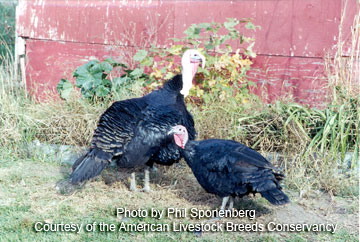
Black turkey originated in Europe as a direct descendant of the Mexican
turkeys carried home with explorers in the 1500s. Black colored turkeys
became popular in Spain where they were known as “Black Spanish”,
and in England, especially in the Norfolk region where they were known
as “Norfolk Blacks.” After being selected for meat production
for more than two centuries, the Black Spanish turkey made the voyage
back to the Americas with early European colonists. Once here, the variety
was crossed with Eastern wild turkeys, which formed the basis for the
Black turkey variety in America. This Black variety was commercially viable
through the early part of the 20th century though not as popular as Bronze,
White Holland, Narragansett, and Bourbon Red varieties. A 1937 Turkey
World article states that Blacks were bred in large numbers along the
East Coast including Maryland and Virginia, their popularity enhanced
by selection for a calm disposition, rapid growth, and early maturation.
The
Black turkey originated in Europe as a direct descendant of the Mexican
turkeys carried home with explorers in the 1500s. Black colored turkeys
became popular in Spain where they were known as “Black Spanish”,
and in England, especially in the Norfolk region where they were known
as “Norfolk Blacks.” After being selected for meat production
for more than two centuries, the Black Spanish turkey made the voyage
back to the Americas with early European colonists. Once here, the variety
was crossed with Eastern wild turkeys, which formed the basis for the
Black turkey variety in America. This Black variety was commercially viable
through the early part of the 20th century though not as popular as Bronze,
White Holland, Narragansett, and Bourbon Red varieties. A 1937 Turkey
World article states that Blacks were bred in large numbers along the
East Coast including Maryland and Virginia, their popularity enhanced
by selection for a calm disposition, rapid growth, and early maturation.
 The
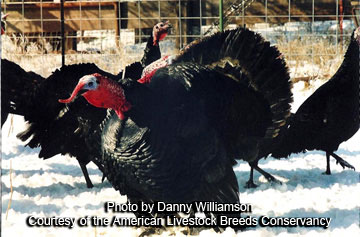
Black was recognized by the American Poultry Association in 1874. The
plumage of this variety is a lustrous, metallic black with a greenish
sheen on top and a dull black undercolor. It is undesirable to have a
brownish or bronze cast or any white. Poults will often have white or
bronze in their feathers but molt into mature plumage. The beak is black,
the wattle is red, changeable to bluish-white, and the shanks and toes
are pink in adults. Eye color is dark brown. Skin of the Black turkey
is usually white, as in all turkey varieties, but some writers speak of
a yellow tinge to the skin that is not seen in other varieties. This may
be influenced by diet, as turkeys on range with access to green feed and
corn tend to have a more yellow cast to the skin. The Standard weight
is 23 pounds for young toms and 14 pounds for young hens, making the Blacks
slightly smaller than the Bronze. Since, however, the Black has not been
selected for production attributes for years, many birds may be smaller
than the breed standard. Careful selection for good health, ability to
mate naturally, and production attributes will return this variety to
its former stature. While generally known as the Black turkey, the terms
“Norfolk Black” and “Black Spanish” are also used
in the United States when referring to this variety, though in the end
all these terms refer to the same Black variety.
The
Black was recognized by the American Poultry Association in 1874. The
plumage of this variety is a lustrous, metallic black with a greenish
sheen on top and a dull black undercolor. It is undesirable to have a
brownish or bronze cast or any white. Poults will often have white or
bronze in their feathers but molt into mature plumage. The beak is black,
the wattle is red, changeable to bluish-white, and the shanks and toes
are pink in adults. Eye color is dark brown. Skin of the Black turkey
is usually white, as in all turkey varieties, but some writers speak of
a yellow tinge to the skin that is not seen in other varieties. This may
be influenced by diet, as turkeys on range with access to green feed and
corn tend to have a more yellow cast to the skin. The Standard weight
is 23 pounds for young toms and 14 pounds for young hens, making the Blacks
slightly smaller than the Bronze. Since, however, the Black has not been
selected for production attributes for years, many birds may be smaller
than the breed standard. Careful selection for good health, ability to
mate naturally, and production attributes will return this variety to
its former stature. While generally known as the Black turkey, the terms
“Norfolk Black” and “Black Spanish” are also used
in the United States when referring to this variety, though in the end
all these terms refer to the same Black variety.
The Black turkey is in need of more stewards. A renewed interest in the
biological fitness, survivability, and superior flavor has captured consumer
interest and created a growing market niche. This personable, attractive
bird can recover to its early 20th century status with the help of a few
more conservation minded producers.
Status: See CPL
Click Here for Breed Clubs and Association Contacts
| The American Livestock Breeds Conservancy | |
PO Box 477 |
ALBC is a trademark
of American Livestock Breeds Conservancy. |
Pittsboro, North Carolina 27312 USA |
|
Telephone: 919-542-5704 |
|
Fax: 919-545-0022 |
|
|
HOME About
ALBC Breed Information Calendar ALBC
Store |
|