"...when the last individual
of a race of living things breathes no more, another Heaven and another
Earth must pass before such a one can be again."
-William Beebe
 • SEARCH ALBC
Buff Turkey
 The
Buff is a historic variety of the mid-Atlantic region named for the beautiful
color of its feathers. Though never widespread, it was accepted by the
American Poultry Association in 1874 and used in the development of the
Bourbon Red variety in the late 1800s. The Bourbon Red, selected more
purposefully for performance and promoted more widely, gained prominence,
causing Buff numbers to decline. Even though the breed’s color was
advantageous for processing because of the nearly white pinfeathers, the
Buff was not extensively selected for other performance qualities and
by the early 1900s this variety had become rare. An additional obstacle
to the Buff’s success was the difficulty of breeding birds to meet
the Buff color standard, which called for even buff coloration throughout
with light flight feathers. By 1915, the Buff was removed from the American
Poultry Association’s Standard of Perfection and ultimately became
extinct.
The
Buff is a historic variety of the mid-Atlantic region named for the beautiful
color of its feathers. Though never widespread, it was accepted by the
American Poultry Association in 1874 and used in the development of the
Bourbon Red variety in the late 1800s. The Bourbon Red, selected more
purposefully for performance and promoted more widely, gained prominence,
causing Buff numbers to decline. Even though the breed’s color was
advantageous for processing because of the nearly white pinfeathers, the
Buff was not extensively selected for other performance qualities and
by the early 1900s this variety had become rare. An additional obstacle
to the Buff’s success was the difficulty of breeding birds to meet
the Buff color standard, which called for even buff coloration throughout
with light flight feathers. By 1915, the Buff was removed from the American
Poultry Association’s Standard of Perfection and ultimately became
extinct.
 Interest
in creating a buff colored turkey returned once again the 1940’s.
The New Jersey Agricultural Experiment Station at Millville initiated
a program to develop a small to medium size market turkey. This is one
of the few instances where a new variety was developed in a methodical
manner: the Beltsville Small White and the commercial Large White being
other examples. The new buff colored birds, called “Jersey Buffs”,
were developed through pedigree breeding and selection from crosses of
Black, Bourbon Red and Broad Breasted Bronze varieties. It is interesting
that the original Buff was used in developing the Bourbon Red and then
in turn the Bourbon Red was used in developing the newer Jersey Buff variety.
A single gene for red is the same in both varieties.
Interest
in creating a buff colored turkey returned once again the 1940’s.
The New Jersey Agricultural Experiment Station at Millville initiated
a program to develop a small to medium size market turkey. This is one
of the few instances where a new variety was developed in a methodical
manner: the Beltsville Small White and the commercial Large White being
other examples. The new buff colored birds, called “Jersey Buffs”,
were developed through pedigree breeding and selection from crosses of
Black, Bourbon Red and Broad Breasted Bronze varieties. It is interesting
that the original Buff was used in developing the Bourbon Red and then
in turn the Bourbon Red was used in developing the newer Jersey Buff variety.
A single gene for red is the same in both varieties.
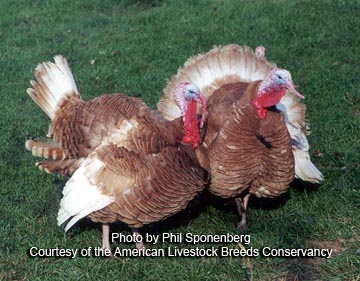
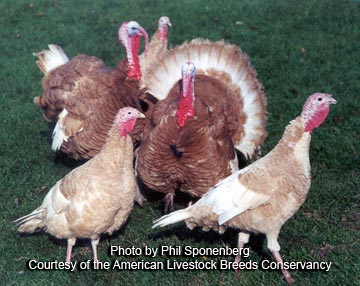
The Jersey Buff has rich reddish-buff colored body feathers. Tail feathers are white with a light buff bar across them near the end. Primary and secondary wing feathers are white with buff shading. It is difficult to have the Jersey Buff males and females match in color since the females tend to lighten with age, especially after a molt. For both toms and hens, the shanks and toes are bluish-white or flesh colored, the beard is black and the eyes are hazel.
Young toms weigh about 21 pounds and mature hens about 12 pounds, both present a clean carcass when dressed. The Jersey Buff has not been recently selected for production attributes, including weight gain and many birds will be smaller than stated. The hens have been known to be good egg producers. Careful selection for good health, ability to mate naturally, and production attributes will help ensure the survival of Jersey Buff turkeys. The Jersey Buff is a calm bird and easy to work with and would be ideal for a small scale or hobby farm.
Status: See CPL
| The American Livestock Breeds Conservancy | |
PO Box 477 |
ALBC is a trademark
of American Livestock Breeds Conservancy. |
Pittsboro, North Carolina 27312 USA |
|
Telephone: 919-542-5704 |
|
Fax: 919-545-0022 |
|
|
HOME About
ALBC Breed Information Calendar ALBC
Store |
|