"...when the last individual
of a race of living things breathes no more, another Heaven and another
Earth must pass before such a one can be again."
-William Beebe
 • SEARCH ALBC
Clydesdale Horse
 The
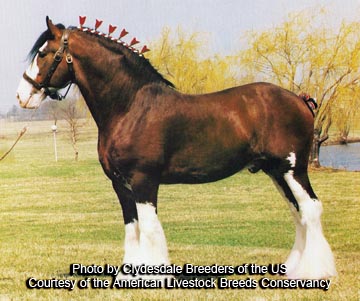
Clydesdale is a draft horse breed from Lanarkshire, Scotland, and its
name was inspired by the River Clyde. The Clydesdale’s history goes
back to the mid-1700s, when native stocks were mated with larger Flemish
horses and then -selected for use in agriculture and for all types of
heavy hauling, including transport through the streets of Glasgow. Clydesdale
horses were first exhibited under the breed name in 1826, and the breed
was further standardized through the -system of hiring out purebred stallions.
The Clydesdale Horse Society was formed in 1877, and its breed registry
records go back to the 1830s.
The
Clydesdale is a draft horse breed from Lanarkshire, Scotland, and its
name was inspired by the River Clyde. The Clydesdale’s history goes
back to the mid-1700s, when native stocks were mated with larger Flemish
horses and then -selected for use in agriculture and for all types of
heavy hauling, including transport through the streets of Glasgow. Clydesdale
horses were first exhibited under the breed name in 1826, and the breed
was further standardized through the -system of hiring out purebred stallions.
The Clydesdale Horse Society was formed in 1877, and its breed registry
records go back to the 1830s.
The Clydesdale was first imported to North America in the 1840s. The breed’s attractiveness and size led to its use in promotional hitches, such as one sponsored by the Chicago Stockyard Company. In the 1930s, the Anheuser Busch Company of St. Louis, Missouri, began to use a hitch of Clydesdales to celebrate the end of Prohibition and to represent the company’s products. The "Budweiser Clydesdales" were an immediate sensation when they delivered the first post-Prohibition beer to the White House, and the hitch has proven to be one of the most popular and successful advertising symbols of all time. Less well known is the fact that Anheuser Busch has maintained a Clydesdale breeding program since 1953, and that the company’s commitment to the breed during the 1950s and 1960s was critical to its survival in North America.
The Clydesdale combines strength and style. The breed’s action is distinctive, with each foot lifted cleanly off the ground so that the bottom of the foot is visible from behind. The forelegs are well planted under the shoulders, the legs are straight, and the feet are durable. Clydesdales should have breadth between the eyes, with a flat facial profile and a wide muzzle. The withers are high, the back short, and the quarters long and well-muscled. The most common color is bay, though black, brown, chestnut, and roan are also seen. The Clydesdale resembles the Shire, and the breeds are related.
As with many breeds of livestock, the Clydesdale has evolved during the 1900s to meet the changing demands of the times. In the early 1900s, the market favored a compact animal. More recently, breeders have selected for a taller horse to be used in fancy hitches and in the show ring. Today’s Clydesdales stand 16.2-18 hands (66-72") at the withers and weigh 1600-1800 pounds. The largest individuals are taller, weighing as much as 2200 pounds.
The North American population of Clydesdale horses has increased steadily
during the past thirty years, and the population is now at an all-time
high, with more purebred foals registered annually than ever before. Globally,
the breed is well known but not common, with an estimated global population
of about 5,000 horses.
Status: See CPL
| The American Livestock Breeds Conservancy | |
PO Box 477 |
ALBC is a trademark
of American Livestock Breeds Conservancy. |
Pittsboro, North Carolina 27312 USA |
|
Telephone: 919-542-5704 |
|
Fax: 919-545-0022 |
|
|
HOME About
ALBC Breed Information Calendar ALBC
Store |
|