"...when the last individual
of a race of living things breathes no more, another Heaven and another
Earth must pass before such a one can be again."
-William Beebe
 • SEARCH ALBC
Dales Pony
The
Dales Pony is one of five native pony breeds of England, the others being
the Dartmoor, Exmoor, Fell and New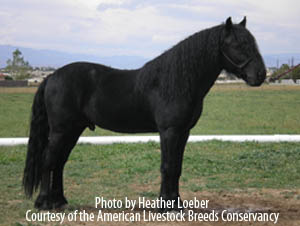 Forest. These breeds descend from the
ancient Celtic horses of northern Europe that had migrated to the British
Isles. The Dales originated in the uplands of northern England where they
were used as pack animals for the lead-mining industry on the eastern
slopes of the Pennines. (Their close cousin, the Fell pony, was used on
the western slopes.) Until the 1800s, this hardy pony carried loads of
lead ore down to the coast from the mines, then returned carrying coal,
traveling 200 miles per week over rocky, rugged terrain. As the railroad
became the main method of transport for the mining industry, the pony
moved onto the hilly farms, serving as a small draft, carriage and riding
animal.
Forest. These breeds descend from the
ancient Celtic horses of northern Europe that had migrated to the British
Isles. The Dales originated in the uplands of northern England where they
were used as pack animals for the lead-mining industry on the eastern
slopes of the Pennines. (Their close cousin, the Fell pony, was used on
the western slopes.) Until the 1800s, this hardy pony carried loads of
lead ore down to the coast from the mines, then returned carrying coal,
traveling 200 miles per week over rocky, rugged terrain. As the railroad
became the main method of transport for the mining industry, the pony
moved onto the hilly farms, serving as a small draft, carriage and riding
animal.
The early ancestry of the Dales is obscure. Its lineage is thought to
include the now-extinct Scottish Galloway pony and Friesian stocks imported
from the Netherlands by the Romans during the 2nd century AD. These ponies
survived on the rugged hills of Britain. As the mining industry turned
to the railroad for transportation the Dales pony found new employment
on the hill farms as a small draft animal. It was used in the field, for
transportation, for herding sheep and for pleasure. During this time the
Dales pony was bred to the Clydesdale horse to increase the pony’s
size. As carriage driving became popular, Norfolk Trotter and the Yorkshire
blood was introduced to add flashy knee and hock action as the ponies.
 During the World Wars the Dales Pony was drafted into the British military
to carry armaments. While this was a good job, it was a dangerous one.
Many Dales were killed in the wars. Most of those that survived were left
behind on the European mainland. Following WWII mechanization replaced
most draft animals and many surviving Dales became food for hungry post-war
Europeans. In 1955 only 4 fillies were registered with the breed association.
Breed enthusiasts recognized the crisis. Concerted conservation efforts
included locating unregistered stock. Three Fell Pony stallions were used
in the 1960s to help resurrect the breed. By 1971 the breed had stepped
back from the brink of extinction.
During the World Wars the Dales Pony was drafted into the British military
to carry armaments. While this was a good job, it was a dangerous one.
Many Dales were killed in the wars. Most of those that survived were left
behind on the European mainland. Following WWII mechanization replaced
most draft animals and many surviving Dales became food for hungry post-war
Europeans. In 1955 only 4 fillies were registered with the breed association.
Breed enthusiasts recognized the crisis. Concerted conservation efforts
included locating unregistered stock. Three Fell Pony stallions were used
in the 1960s to help resurrect the breed. By 1971 the breed had stepped
back from the brink of extinction.
In 1991 twelve ponies were imported to Canada. In 1994, three fillies
and one colt were imported to the US. According to the Canadian Mountain
and Moorland Society, the North American breed association for the Dales
Pony, in 1999 approximately 60 ponies were listed in the North American
stud book, with the global population estimated at 800. Today the Dales
pony, valued for their stamina, shows potential as an endurance or trekking
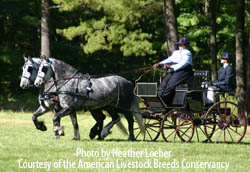
mount. It is used in combined driving events, as well as under saddle,
and can easily carry an adult rider.
The Dales pony may stand up to 14.2 hands (58”) at the withers,
slightly larger than the Fell, to whom it is closely related. It has a
strong, compact build with feathered fetlocks, dense, flat bones and 8-9”
cannon bones. It is known for its hard, large feet, and strong legs. Coat
color is predominantly black but some animals are brown, gray, bay, and
rarely roan. The Dales is known and valued for its tremendous stamina,
courage, intelligence, thriftiness and calm temperament.
Status: See CPL
| The American Livestock Breeds Conservancy | |
PO Box 477 |
ALBC is a trademark
of American Livestock Breeds Conservancy. |
Pittsboro, North Carolina 27312 USA |
|
Telephone: 919-542-5704 |
|
Fax: 919-545-0022 |
|
|
HOME About
ALBC Breed Information Calendar ALBC
Store |
|