"...when the last individual
of a race of living things breathes no more, another Heaven and another
Earth must pass before such a one can be again."
-William Beebe
 • SEARCH ALBC
Goats
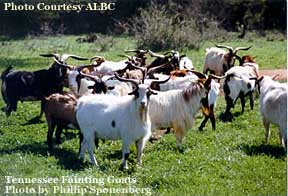
Adaptable, curious, and sociable, goats were among the first animals to be domesticated. Goats’ hardiness makes them a part of subsistence agriculture almost everywhere, yet they are also found in highly developed production systems and as pampered companion animals. The global distribution of goats, as well as their many uses, has led to the development of a large number of standardized breeds and landraces, though most of these are not well documented.
Goats are among the most versatile of all domestic animals, used for
milk, meat, and fiber, and for packing and land management. Goat milk is inexpensive to produce,
easy to digest, and nutritionally rich. Demand for goat milk has encouraged
the development of many specialized dairy breeds, especially in Europe
and India.
for packing and land management. Goat milk is inexpensive to produce,
easy to digest, and nutritionally rich. Demand for goat milk has encouraged
the development of many specialized dairy breeds, especially in Europe
and India.
Goat meat is consumed worldwide. Despite the importance of meat, however, few specialized meat breeds have been developed. Foremost among these is the Boer goat of South Africa, which has recently become established in several other countries, including the United States.
While all goats grow hair coats, some produce specialized and valuable fiber types – such as mohair and cashmere. Mohair [, often considered a luxury fiber,] is a long lustrous fiber produced by Angora goats. It is similar to the lustrous long wool of sheep, but distinct from the angora fiber produced by Angora rabbits.
Cashmere is quite different from mohair and is a true luxury fiber. It is the soft undercoat which can be produced by nearly any type of goat. Some goats produce an excellent quantity and quality of cashmere, and while these goats do not constitute a true breed in the genetic sense, they are generally referred to as a breed.
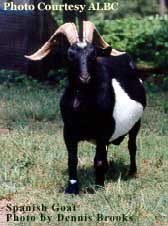
The history of goats in North America began with the arrival of Spanish explorers and settlers in the 1500s. English settlers brought a few goats to New England beginning in the 1600s. These two types accounted for most of the goats found in North America until the time of the Civil War. These goats had little market value and were never recognized as distinct breeds.
 In
the mid-1800s, goat production in the United States began to change. The
importation of several goat breeds from Europe increased the breadth of
genetic resources available. Angora goats were imported to the United
States beginning in the 1850s, and Texas became the center of mohair production.
Importation of improved European dairy breeds, including the Toggenburg,
Saanen, French Alpine, and Nubian, began about 1900. Diary production
from these breeds far exceeded that of the Spanish and English goats,
and these historic types were rapidly crossbred or replaced. The Old English
goat became extinct in North America, and it was only in the southeastern
and southwestern United States that pure Spanish goats survived.
In
the mid-1800s, goat production in the United States began to change. The
importation of several goat breeds from Europe increased the breadth of
genetic resources available. Angora goats were imported to the United
States beginning in the 1850s, and Texas became the center of mohair production.
Importation of improved European dairy breeds, including the Toggenburg,
Saanen, French Alpine, and Nubian, began about 1900. Diary production
from these breeds far exceeded that of the Spanish and English goats,
and these historic types were rapidly crossbred or replaced. The Old English
goat became extinct in North America, and it was only in the southeastern
and southwestern United States that pure Spanish goats survived.
Recently imported cashmere goats have been crossed with Spanish goats to increase the production of fiber. Boer goats from south Africa have been imported and crossed with Spanish, Tennessee Fainting, and other breeds to improve meat production. The resulting offspring demonstrate the commercial and biological value of hybrid vigor from the use of two unrelated breeds. At the same time, crossbreeding poses a threat to the survival of Spanish and Tennessee goat breeds, both of which are unique to the United States.
Excerpted from A Rare Breeds Album of American Livestock, pg 39-40
| The American Livestock Breeds Conservancy | |
PO Box 477 |
ALBC is a trademark
of American Livestock Breeds Conservancy. |
Pittsboro, North Carolina 27312 USA |
|
Telephone: 919-542-5704 |
|
Fax: 919-545-0022 |
|
|
HOME About
ALBC Breed Information Calendar ALBC
Store |
|