"...when the last individual
of a race of living things breathes no more, another Heaven and another
Earth must pass before such a one can be again."
-William Beebe
 • SEARCH ALBC
Malay Chicken
When one thinks of ancient landraces of poultry, one breed stands heads above the rest of the flock – the Malay 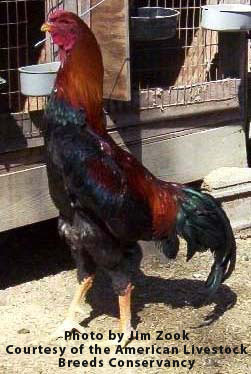 chicken. Standing as tall as 26” to 30”, with cocks weighing 9 lbs and hens 7 lbs, Malays were said to be able to eat grain from the top of a barrel or a common dining-table. The breed achieves its great height from a combination of long neck, long legs, and upright carriage of body. At the time Europeans first encountered them, Malay chickens were widely distributed throughout the Orient, in particular from north India to Indonesia and Malaysia. The breed was unlike any other previously known, with its extreme height, heavy bones, broad skull, short-stout beak, and its pugnacious nature. By 1830 the breed had been brought to England, where it became fashionable to include in a collection of poultry. By 1834 Malay chickens were to be found in Holland and Germany. And by 1846 the breed had traveled to America. The Malay chicken, like the Aseel of India, is an extremely ancient breed. It is supposed to have descended from the great Malay, or Kulm, fowls of India. And though the Aseel breeds dates back some 3500 years, it is not possible to know which breed is older.
The Malay chicken was the first of the gigantic Asiatic fowl introduced to the western world. The breed’s unique appearance attracted attention, but it was found wanting as general fowl. Historically, as a meat producing fowl, the Malay had as many detractors as followers. Some writers criticized the meat for being coarse and dry in nature, while others extolled the firm grain and large amount of meat the breed produces. The breed does tend to be lean, a benefit in tropical climates, and does not lay fat on the breast.
Over the many years since it was first discovered, the most useful role that the Malay chicken has played is that of crossing with other breeds. Many breeders have used the breed to regenerate lines of Oriental fowl – from Games to Longtails. Malays seems to impart strong vitality when so used. Undoubtedly, its ancient heritage and unique characteristics make it a distinct genetic package, and thus account for this useful feature.
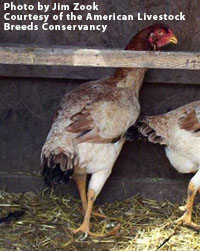 The Malay chicken has many unique attributes. The crow of the cock is hoarse, short, and monotonous – reminiscent of a roar. It has small wattles and is inclined to be bare on throat and breast. The comb is low and thick, being strawberry in shape. The beak is short, broad and hooked. The expression of the Malay is snaky and cruel, its pearl eye color and overhanging brows contributing much to this appearance. Feathers of the Malay chicken tend to be very close to the body, lacking fluff, firm, narrow and very glossy; with a lustrous sheen when viewed in daylight. And the legs are yellow with remarkably large scales.
Personality and character of Malay chickens are unique as well. They are quite quarrelsome and this trait only gets worse in confinement. The breed is prone to eating each other’s feathers. Though the females are good mothers, the males can be quite cruelly disposed to their chicks. While the chicks can be quite delicate, the adult Malay chickens are very hardy. The breed’s gait is heavy and, curiously, they tend to rest their shanks on the ground when tired – often standing taller than other breeds while doing so. The hens are poor and seasonal layers. Malay hens brood well, though with their short, narrow, tight feathers they cannot cover many eggs.
The Malay chicken was first recognized as a standard breed by the American Poultry Association (APA) in 1883 in the Black Breast Red variety. White, Spangled, Black, and Red Pyle Malays were not recognized by the APA as varieties until 1981.
Status: See CPL
Click Here for Breed Clubs and Association Contacts
| The American Livestock Breeds Conservancy | |
PO Box 477 |
ALBC is a trademark
of American Livestock Breeds Conservancy. |
Pittsboro, North Carolina 27312 USA |
|
Telephone: 919-542-5704 |
|
Fax: 919-545-0022 |
|
|
HOME About
ALBC Breed Information Calendar ALBC
Store |
|