"...when the last individual
of a race of living things breathes no more, another Heaven and another
Earth must pass before such a one can be again."
-William Beebe
 • SEARCH ALBC
Miniature Donkey
Miniature donkeys have been valued in the Mediterranean region for over two thousand years. They wer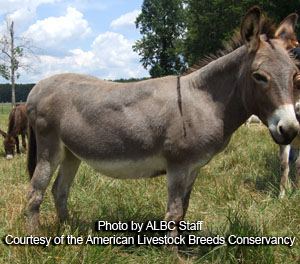 e used as a means of draft and transport as well as for the power to grind wheat. Donkey milk was utilized as a curative and skin treatment as well. It was said that Poppea, Nero’s wife, kept a herd of jennets to produce milk for her baths!
Miniature Donkeys were first imported to the United States in 1929 by Robert Green, a New York stockbroker. He bought seven Sardinian donkeys, sight unseen, while on a trip to Europe. Later imports by the Busch family (of Clydesdale fame) and others increased the numbers somewhat, but it was not until the last twenty years that the breed has been widely known and available in North America. The Miniature Donkey Registry was formed in 1958 and is now operated by the American Donkey and Mule Society. The National Miniature Donkey Association was formed in 1990 to promote the breed and educate breeders about its stewardship.
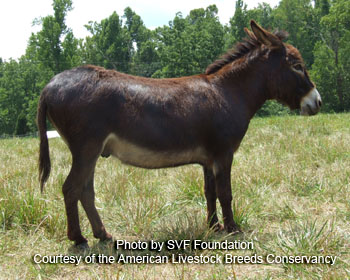 Miniature Donkeys have curious, engaging dispositions, and they make great pets. A donkey’s first instinct when alarmed or confused is to stand still. This cautious approach, frequently mistaken for stubbornness, can be a great asset especially around children. Donkeys average 34" high at the withers, with 36" the maximum height allowed in the breed. They weigh 200-350 pounds. Gray dun with a dorsal stripe is the most common color, though black, brown, sorrel, white, and spotted animals are also seen. Many breeders have cultivated the variety of colors found in the breed, especially since donkeys of rarer colors often bring higher prices.
North American breeders have selected their animals as small sized companion animals, and the market has rewarded such selection. At the same time, the breed’s thrifty nature, long life span (25-35 years), and easy keeping qualities reflect its past as a sturdy work animal. The National Miniature Donkey Association is encouraging broad based selection that includes soundness, fertility, and other performance qualities to conserve the breed’s complete genetic heritage.
North America boasts 10,000-15,000 Miniature Donkeys, and numbers are increasing. Miniature Donkeys in the Mediterranean region are, however, disappearing, as the small working donkeys are being crossed with larger breeds. For this reason, the donkeys in North America are of global genetic value and merit continued stewardship from breeders in the United States and Canada.
Status: See CPL
| The American Livestock Breeds Conservancy | |
PO Box 477 |
ALBC is a trademark
of American Livestock Breeds Conservancy. |
Pittsboro, North Carolina 27312 USA |
|
Telephone: 919-542-5704 |
|
Fax: 919-545-0022 |
|
|
HOME About
ALBC Breed Information Calendar ALBC
Store |
|