"...when the last individual
of a race of living things breathes no more, another Heaven and another
Earth must pass before such a one can be again."
-William Beebe
 • SEARCH ALBC
Nigerian Dwarf Goat
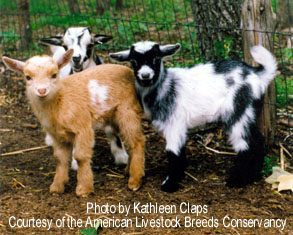 Two
miniature goat breeds are found in the United States, the Nigerian Dwarf
and the Pygmy. These breeds share a common genetic origin in the variable
population of small African goats imported to the United States between
the 1930s and 1950s. Used originally as exhibition animals in zoos, the
goats later became popular as companion animals.
Two
miniature goat breeds are found in the United States, the Nigerian Dwarf
and the Pygmy. These breeds share a common genetic origin in the variable
population of small African goats imported to the United States between
the 1930s and 1950s. Used originally as exhibition animals in zoos, the
goats later became popular as companion animals.
The Pygmy goat breed was recognized by the American Goat Society in 1976.
During the last two decades, it has been standardized through selection
for small size and stocky conformation. The breed includes a limited color
range, primarily agouti, though other solid colors along with the belted
color pattern are also accepted.
The Nigerian Dwarf breed originated from the same genetic foundation as
the Pygmy, but these goats have been selected to resemble miniature dairy
goats with more slender bodies. All colors and patterns, including bi-
and tri-color combinations, are accepted. Horns may or may not be present.
Nigerian Dwarf goats vary in size, with bucks’ height up to 23 1/2"
at the withers and does’ height up to 22 1/4". The ideal size
of the breed, however, remains a point of debate within the breeder community,
and there are now several breed organizations reflecting differing philosophies.
The Nigerian Dwarf was originally selected as a companion and show animal,
with emphasis on the breed’s graceful appearance and gentle disposition.
The production qualities of the breed, however, have also attracted attention.
Nigerian Dwarf does produce one to two quarts of milk per day. The milk
is high in butterfat and makes excellent cheese and butter. Does generally
breed year-round and produce twins. They can be milked for up to ten months,
but can also be allowed to dry up on their own if milking is no longer
desired. These production qualities make Nigerian Dwarf goats good candidates
for small scale milk production where a year-round supply of a moderate
amount of milk is the goal.
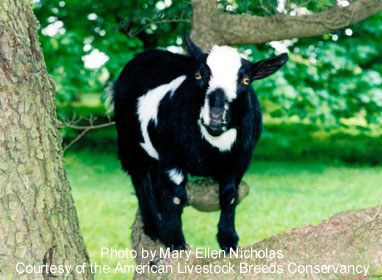 The
versatility of the Nigerian Dwarf, as well as its hardiness and gentle
disposition, have given it great appeal, and the breed’s population
has increased significantly in recent years, registering nearly 7000 purebred
animals in 2002. The breeder community faces a challenge, however, in
determining the parameters of the breed. Selection for production qualities
may tend to increase the size of the goats, while selection as a companion
animal may emphasize small size. Breed conservation will be best served
by building consensus around a vision for the breed that includes its
unique combination of characteristics.
The
versatility of the Nigerian Dwarf, as well as its hardiness and gentle
disposition, have given it great appeal, and the breed’s population
has increased significantly in recent years, registering nearly 7000 purebred
animals in 2002. The breeder community faces a challenge, however, in
determining the parameters of the breed. Selection for production qualities
may tend to increase the size of the goats, while selection as a companion
animal may emphasize small size. Breed conservation will be best served
by building consensus around a vision for the breed that includes its
unique combination of characteristics.
Status: See CPL
| The American Livestock Breeds Conservancy | |
PO Box 477 |
ALBC is a trademark
of American Livestock Breeds Conservancy. |
Pittsboro, North Carolina 27312 USA |
|
Telephone: 919-542-5704 |
|
Fax: 919-545-0022 |
|
|
HOME About
ALBC Breed Information Calendar ALBC
Store |
|