"...when the last individual
of a race of living things breathes no more, another Heaven and another
Earth must pass before such a one can be again."
-William Beebe
 • SEARCH ALBC
Orpington Chicken
During the late 1800s “Hen Fever”, that great public interest in strange and wonderful new chicken 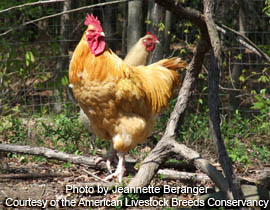 breeds from around the world, started to die down and in its aftermath a love of poultry remained, now tempered by a desire for practicality. Dual-purpose American chicken breeds were just reaching England where they were respected for their practical qualities, but disparaged for their yellow skin (the British preferring white skin). William Cook was a humble coachman living in the Kentish town of Orpington, in England, and he had an idea. He began crossing Minorca roosters with Black Plymouth Rock hens, and then the offspring to clean-legged Langshan chickens. His goal was to develop a hardy, fast growing chicken that laid well and yet had the table qualities the British market sought. In 1886 he introduced his creation to the public – it was a success and within 10 years Orpington chickens were well established in England and began to be exported to other countries.
William Cook enjoyed a rare commodity – success – and his fortunes grew. But it is not his entrepreneurial spirit that is to be celebrated, but his skill in breeding. Mr. Cook focused his breeding efforts on developing the body and productive traits of his poultry; in the process many birds came as they might in color pattern. Thus Mr. Cook had the bright idea to create many varieties of his Orpington chickens. He first introduced the Black, and then the White Orpington, the Buff, the Jubilee [Speckled], and the Spangled [Mottled]. His son-in-law, A.C. Gilbert, created the Blue and the Cuckoo Orpingtons.
Orpington chickens reached America by 1891. In 1903 William Cook himself brought over a large importation and showed them in America. Farmers of the mid-western states favored the Buff Orpington chicken for its generally superior table-qualities, and its unique color – different than most general-purpose breeds. Orpingtons continued to boom until the poultry industry experienced a depression about 1912.
The qualities that won all the Orpington chicken varieties recognition were fast rate of growth, excellent egg production, and excellent table-quality. Historically, Orpington chickens made excellent broilers weighing 2 to 2.5 lbs at 8-10 weeks of age, excellent roasting chickens at 5 months of age, and excellent old fowl for the table as well. They are first-rate layers of large light to dark brown eggs. In fact, they were entered into the first egg-laying contest, held at the North Yorkshire farm of Simon Hunter of Northallerton, England, in 1887.
Orpington chickens were recognized by the American Poultry Association as a standard bred in four varieties: Buff, 1902; Black, 1905; White, 1905; and Blue, 1923. Males weigh 10lbs, females 8 lbs.
Status: See CPL
| The American Livestock Breeds Conservancy | |
PO Box 477 |
ALBC is a trademark
of American Livestock Breeds Conservancy. |
Pittsboro, North Carolina 27312 USA |
|
Telephone: 919-542-5704 |
|
Fax: 919-545-0022 |
|
|
HOME About
ALBC Breed Information Calendar ALBC
Store |
|