"...when the last individual
of a race of living things breathes no more, another Heaven and another
Earth must pass before such a one can be again."
-William Beebe
 • SEARCH ALBC
Pineywoods Cattle
 The
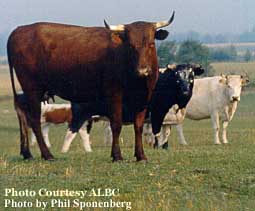
Pineywoods is one of the oldest breeds of cattle in the United States,
descending from Spanish cattle brought to the Americas beginning in the
early 1500s. Spanish colonists established low-input, extensive cattle-ranging
systems typical of Spanish -ranching. The Pineywoods, Florida Cracker,
Texas Longhorn, and other breeds which were developed are called criollo
cattle, which means “of -European origin but born in the New World.”
The
Pineywoods is one of the oldest breeds of cattle in the United States,
descending from Spanish cattle brought to the Americas beginning in the
early 1500s. Spanish colonists established low-input, extensive cattle-ranging
systems typical of Spanish -ranching. The Pineywoods, Florida Cracker,
Texas Longhorn, and other breeds which were developed are called criollo
cattle, which means “of -European origin but born in the New World.”
The Pineywoods breed was shaped primarily by agricultural and environmental
conditions in Alabama, Mississippi, Georgia, and other parts of the southeastern
United States. This, along with some human selection, has resulted in
a breed that is heat tolerant, long-lived, resistant to parasites and
diseases, and able to be productive on marginal forage. Pineywoods cattle
were used in the production of beef, and occasionally used as dairy cattle.
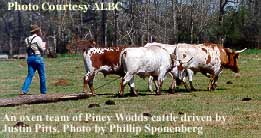
They also played an important role as oxen in the timber industry of the
Southeast.The Pineywoods breed became rare during the late 1800s and early
1900s, when improved English and European cattle were brought into the
Southeast. Wherever these breeds could tolerate the environmental conditions,
they replaced the native Pineywoods. Improved cattle were also crossed
with Pineywoods cows to produce calves which had the survival qualities
of the dam and the production qualities of the sire. The overuse of crossbreeding
almost eliminated the purebred Pineywoods stocks, and the breed nearly
became extinct.
 Only
a few families continued to keep purebred Pineywoods herds. As time passed,
their herds became isolated from one another, until each herd became a
unique and self-contained strain. Today these strains are the most important
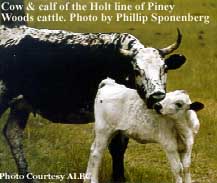
genetic elements of the breed. The strains are named after the families
who conserved them: Holt in Georgia, Barnes in Alabama, and Conway, Bayliss,
and Carter in Mississippi. Some of these strains have long and interesting
histories. The Carter strain, for example, began in the 1860s when Print
Carter, a sixteen-year-old Civil War veteran, swam a herd of red cows
over the Pearl River and began raising cattle. The last outside animal
to enter the herd was a bull in 1895, yet the herd thrives today.
Only
a few families continued to keep purebred Pineywoods herds. As time passed,
their herds became isolated from one another, until each herd became a
unique and self-contained strain. Today these strains are the most important
genetic elements of the breed. The strains are named after the families
who conserved them: Holt in Georgia, Barnes in Alabama, and Conway, Bayliss,
and Carter in Mississippi. Some of these strains have long and interesting
histories. The Carter strain, for example, began in the 1860s when Print
Carter, a sixteen-year-old Civil War veteran, swam a herd of red cows
over the Pearl River and began raising cattle. The last outside animal
to enter the herd was a bull in 1895, yet the herd thrives today.
 As
one would expect of heat-tolerant cattle, Pineywoods are small and rugged.
They exhibit the angular appearance of other Spanish cattle which have
become adapted to harsh conditions. Size and selection for beef conformation
vary, -increasing in the western and northern portions of the range. Cows
weigh 600-800 pounds, and bulls average 800-1,200 pounds.
A very few “Guinea,” or dwarf cattle, are found in the breed.
Most Pineywoods cattle are horned, and the horns vary from long and twisted
to short and crumpled.
As
one would expect of heat-tolerant cattle, Pineywoods are small and rugged.
They exhibit the angular appearance of other Spanish cattle which have
become adapted to harsh conditions. Size and selection for beef conformation
vary, -increasing in the western and northern portions of the range. Cows
weigh 600-800 pounds, and bulls average 800-1,200 pounds.
A very few “Guinea,” or dwarf cattle, are found in the breed.
Most Pineywoods cattle are horned, and the horns vary from long and twisted
to short and crumpled.
The Pineywoods breed includes almost all of the solid colors and many of the spotting patterns known to cattle. This is a legacy from Spain, where even today ranchers prefer multicolored herds for range conditions. Some of the family strains have been selected for specific -colors or patterns. Conway cattle, for example, are red and white in various patterns. Holt cattle are nearly always black color-sided roan, although James Holt’s father preferred solid-colored duns and had entire herds of that color. Griffen cattle tend to be yellow. Other strains, such as Carter and Barnes, -include several colors.
The Pineywoods is critically rare, with only 1500-2000 cattle alive today. Though little known outside the Southeast, the Pineywoods, and the closely related Florida Cracker breed, are high conservation priorities. These American breeds have important qualities, such as fertility and longevity, that are lacking in the Brahman, Zebu, and other heat-tolerant cattle commonly used. The Pineywoods, with almost 500 years of adaptation to the American Southeast, has history on its side as well.
Read the ALBC publication: An Overview and History of Pineywoods Cattle, The Culture and Families that Shaped the Breed
Status: See CPL
| The American Livestock Breeds Conservancy | |
PO Box 477 |
ALBC is a trademark
of American Livestock Breeds Conservancy. |
Pittsboro, North Carolina 27312 USA |
|
Telephone: 919-542-5704 |
|
Fax: 919-545-0022 |
|
|
HOME About
ALBC Breed Information Calendar ALBC
Store |
|