"...when the last individual
of a race of living things breathes no more, another Heaven and another
Earth must pass before such a one can be again."
-William Beebe
 • SEARCH ALBC
Red Wattle Hog
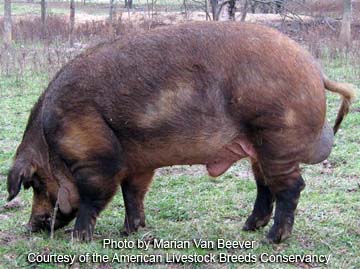 The Red Wattle is a large, red hog with a fleshy wattle attached to each
side of the neck. The wattles have no known function. They are a single
gene characteristic and usually pass to crossbred offspring. The Red Wattle
comes in a variety of shades of red, some with black specks or patches,
and red and black hair. Some individuals are nearly black. The head and
jowl are clean and lean, the nose is slim, and ears are upright with drooping
tips. The body is short coupled and the back slightly arched. Mature animals
weigh 600-800 pounds, but may weigh as much as 1200 pounds and measure
up to four feet high and eight feet long.
The Red Wattle is a large, red hog with a fleshy wattle attached to each
side of the neck. The wattles have no known function. They are a single
gene characteristic and usually pass to crossbred offspring. The Red Wattle
comes in a variety of shades of red, some with black specks or patches,
and red and black hair. Some individuals are nearly black. The head and
jowl are clean and lean, the nose is slim, and ears are upright with drooping
tips. The body is short coupled and the back slightly arched. Mature animals
weigh 600-800 pounds, but may weigh as much as 1200 pounds and measure
up to four feet high and eight feet long.
Red Wattle hogs are known for hardiness, foraging activity, and rapid
growth rate. They produce a lean meat that has been described as flavorful
and tender. The sows are excellent mothers, farrow litters of 10 –
15 piglets, and provide good quantities of milk for their large litters.
They have a mild temperament.
Red Wattles adapt to a wide range of climates. Their active foraging make
them a good choice for consideration in outdoor or pasture-based swine
production. Their gentle nature recommends them to the small-scale, independent
producer.
The origin and history of the Red Wattle breed is obscure and many hypotheses
have been put forward. What is certain is that the breed, as it is known
today, was derived from the large, red, wattled hogs found in a wooded
area of eastern Texas in the early 1970s by Mr. H.C. Wengler. He reported
breeding two red wattled sows with a Duroc boar, then breeding the wattled
offspring back to the original sow. Over several generations he developed
what became known as the “Wengler Red Waddle Hog.”
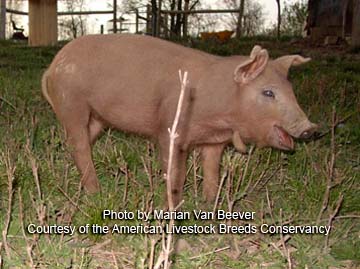 In the early 1980s Robert Prentice located another herd of red wattled
hogs. This line became known as the Timberline, named after its wooded
origins of east Texas. He combined these with the Wengler Red Waddles
to create the Endow Farm Wattle Hogs.
In the early 1980s Robert Prentice located another herd of red wattled
hogs. This line became known as the Timberline, named after its wooded
origins of east Texas. He combined these with the Wengler Red Waddles
to create the Endow Farm Wattle Hogs.
During the early 1980s, a boom time in the hog market, both breeding and
market hogs brought a premium. Crosses with the Red Wattle inherited a
leaner carcass and showed good hybrid vigor. Three organizations served
as registries for Red Wattle hogs and over 100 people were involved with
Red Wattles. The breed, however, has never been supported by an active
breed association. In the mid-1980s the American Livestock Breeds Conservancy
facilitated a meeting of the breeders, encouraging them to unify their
efforts to benefit the breed. The breeders preferred to continue with
the three registry system. ALBC’s 1990 census reported 272 purebred
registered offspring. In late 1999 Jerry Russell began to search for Red
Wattle hogs and found only 42 breeding animals belonging to six breeders.
None of the three registries had registered stock in years. At the breeders
request, ALBC is maintaining a pedigree registry for the breed and providing
technical support. Connected breeders are searching for others who may
have Red Wattle hogs so that all eligible animals can participate in the
breed’s recovery.
The story of the Red Wattle breed illustrates the problems associated
with conservation of regional and local populations. Often poorly documented,
even when common, these breeds can be rapidly lost when no formal network
exists to conserve and promote them.
Status: See CPL
| The American Livestock Breeds Conservancy | |
PO Box 477 |
ALBC is a trademark
of American Livestock Breeds Conservancy. |
Pittsboro, North Carolina 27312 USA |
|
Telephone: 919-542-5704 |
|
Fax: 919-545-0022 |
|
|
HOME About
ALBC Breed Information Calendar ALBC
Store |
|