"...when the last individual
of a race of living things breathes no more, another Heaven and another
Earth must pass before such a one can be again."
-William Beebe
 • SEARCH ALBC
Chinese Goose
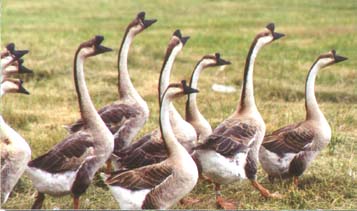 Chinese
geese are considered by many to be the most graceful and beautiful member
of the goose family. They are elegant and dignified on both land and water.
Sometimes referred to as “Swan Geese” because of their long and graceful
necks, they, in fact, descend from the wild swan goose native to Asia
(Holderread, 1986).
Chinese
geese are considered by many to be the most graceful and beautiful member
of the goose family. They are elegant and dignified on both land and water.
Sometimes referred to as “Swan Geese” because of their long and graceful
necks, they, in fact, descend from the wild swan goose native to Asia
(Holderread, 1986).
Chinese geese are exceptionally practical. Of all breeds, they are the best layers, most active foragers, produce the least greasy meat, and, except for Pilgrims, are the easiest to sex at maturity (Holderread, 1981). With good management, the average Chinese goose produces nearly twice as many goslings as other geese, laying 40 – 100 white eggs annually. Because they are alert and vocal, they will raise the alarm if a threat is perceived (Holderread, 1986). Geese eat many grasses and herbaceous plants. If properly managed they can be employed as “weeders.” “Chinese geese are by far the most popular breed for weeding chores due to their active foraging habits, moderate size, unmatched agility, good availability and reasonable prices.” (Holderread, 1986). Poultry catalogs will commonly refer to this breed as “Weeder Geese.”
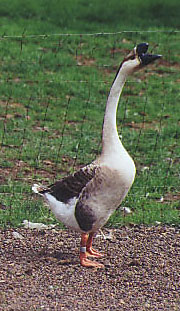 The
Chinese goose is refined and curvaceous. Its bill is relatively long and
slender, with a large, rounded, erect knob that attaches to its forehead.
The Chinese holds its head high. Its head flows seamlessly into a long,
slim, well-arched neck which meets the body at about a 45 degree angle.
Its body is short, compact, has a prominent and well-rounded chest, smooth
breast and no keel. Its abdomen is moderately full but has no fatty lobes,
except during the laying season when the female may develop a single lobe.
The tail should be held high, which is worth noting as this is a good
indication of vitality in ganders. A Chinese goose is often heavier than
it appears, as its feathers are closely fitted. Mature ganders average
12 pounds, mature geese average 10 pounds (Holderread, 1981).
The
Chinese goose is refined and curvaceous. Its bill is relatively long and
slender, with a large, rounded, erect knob that attaches to its forehead.
The Chinese holds its head high. Its head flows seamlessly into a long,
slim, well-arched neck which meets the body at about a 45 degree angle.
Its body is short, compact, has a prominent and well-rounded chest, smooth
breast and no keel. Its abdomen is moderately full but has no fatty lobes,
except during the laying season when the female may develop a single lobe.
The tail should be held high, which is worth noting as this is a good
indication of vitality in ganders. A Chinese goose is often heavier than
it appears, as its feathers are closely fitted. Mature ganders average
12 pounds, mature geese average 10 pounds (Holderread, 1981).
When selecting breeding stock, “pick birds with compact bodies, prominent chests and keelless breasts, wings that fold in front of an erect tail, slender and symmetrically arched necks and large, rounded knobs that rise well above the crown of the head. A spry, upright carriage, is important in Chinese since it is a sign of good health and vigor. Avoid breeding from specimens with drooping shoulders, roach backs, deformed necks and long bodies.” (Holderread, 1981). A ratio of four to six geese per gander, rather than allowing a one to one pairing, reduces competition in the flock (Holderread, 1981). The Chinese is a hardy breed, however their knobs which will freeze when temperatures fall below 20Í to 25Í F (-5Í C). It is important to provide the flock some protection during freezing weather (Holderread, 1986).
There are two color varieties of Chinese geese, brown and white. The original variety is a rich brown and fawn, accented by a dark, russet-brown neck stripe. In mature birds, the glossy black bill and knob are separated from the main head plumage by a narrow band of creamy-white feathers. The shanks and feet are brownish orange or dark orange and the eyes brown. The white variety has blue eyes, pure white plumage, and bright orange feet, knobs and bills. While goslings of white European breeds are mainly gray with yellow trim, the down of day-old White Chinese is a bright canary yellow (Holderread, 1981). Both varieties were admitted to the American Poultry Association’s Standard of Perfection in 1874 (Malone, et. al., 1998).
Chinese geese are a most economical breed. Stock are generally the less expensive than other breeds. Their smaller size coupled with their active foraging ability means they do not require as much food as other breeds. For those looking for “watchdogs” Chinese are an excellent choice for the home flock (Holderread, 1986).
Status: See CPL
Bibliography:
Bender, Marjorie; Sponenberg, D. Phillip;
Bixby, Donald. 2000. Taking Stock of Waterfowl: The results of the
American Livestock Breeds Conservancy’s Domestic Duck and Goose Census.
American Livestock Breeds Conservancy. Pittsboro, North Carolina.
Holderread, Dave. 1986. Breed Bulletin #8622, “Brown Chinese Geese.”
Holderread, Dave. 1981. The Book of Geese: a Complete Guide to Raising the Home Flock. Hen House Publications.
Malone, Pat; Donnelly, Gerald; Leonard, Walt. 1998. American Standard of Perfection. American Poultry Association, Inc. Mendon, MA.
Semonsky, Michael; Bixby, Donald; Bender, Marjorie. 2001. “Fowl Friends in Fields and Fence-Rows: Using geese for weed management.”
| The American Livestock Breeds Conservancy | |
PO Box 477 |
ALBC is a trademark
of American Livestock Breeds Conservancy. |
Pittsboro, North Carolina 27312 USA |
|
Telephone: 919-542-5704 |
|
Fax: 919-545-0022 |
|
|
HOME About
ALBC Breed Information Calendar ALBC
Store |
|