"...when the last individual
of a race of living things breathes no more, another Heaven and another
Earth must pass before such a one can be again."
-William Beebe
 • SEARCH ALBC
Cotton Patch Goose
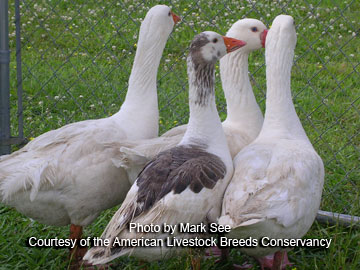 Once
commonplace on farms in the southeastern U.S., the Cotton Patch is a breed
of goose that gets its name from the job it performed. These geese were
used to weed cotton and corn fields up until the 1950s. Cotton Patch geese
are remembered in the rural south for helping many farmers and their families
survive the Great Depression by providing a regular source of meat, eggs,
and grease.
Once
commonplace on farms in the southeastern U.S., the Cotton Patch is a breed
of goose that gets its name from the job it performed. These geese were
used to weed cotton and corn fields up until the 1950s. Cotton Patch geese
are remembered in the rural south for helping many farmers and their families
survive the Great Depression by providing a regular source of meat, eggs,
and grease.
The breed’s beginnings are not clear but it is thought to have derived from European stock brought to the U.S. during the colonial period. Cotton Patch geese posses many qualities that are common in sex-linked European breeds such as the West of England, Shetland, and Normandy geese. However, these breeds are recent importations to North America, and have not played a role in the development of the Cotton Patch goose. The Cotton Patch goose is the remaining relic of a little known American breed of goose with parent stock that probably shares common ancestors with the above mentioned sex-linked geese breeds. Cotton Patch are sexually dimorphic as other sex-linked goose breeds, but differ by having pink or orange-pink bills, light weight bodies, and the ability to fly.
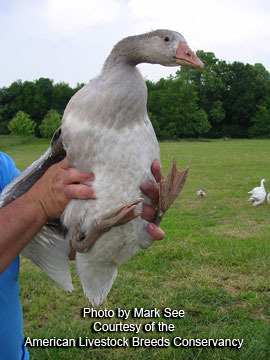 The
Cotton Patch is a “sleek” goose that resembles Greylag geese.
The breed is a light- to medium-sized goose. Because of their smaller
size, the breed has the ability to adjust to hot weather better than most
of the heavier breeds of geese. The Cotton Patch is an “upright”
goose with tail in line with back and wings, giving it a clean wedge shape
without a “prick” tail. The Cotton Patch’s body is more
elongated and is not rounded like that of the Shetland or Pilgrim goose.
Lobe development – the fat flaps between the legs of a goose –
is minimal and a single lobe, if any, becomes present with supplemental
feeding. Without supplemental feed, a lobe is not present.
The
Cotton Patch is a “sleek” goose that resembles Greylag geese.
The breed is a light- to medium-sized goose. Because of their smaller
size, the breed has the ability to adjust to hot weather better than most
of the heavier breeds of geese. The Cotton Patch is an “upright”
goose with tail in line with back and wings, giving it a clean wedge shape
without a “prick” tail. The Cotton Patch’s body is more
elongated and is not rounded like that of the Shetland or Pilgrim goose.
Lobe development – the fat flaps between the legs of a goose –
is minimal and a single lobe, if any, becomes present with supplemental
feeding. Without supplemental feed, a lobe is not present.
The Cotton Patch’s head is rounded and the beak is dished. There is one strain that more closely resembles the Pilgrim and has a beak that is slightly “roman”. The ganders in this strain tend to have as many gray feathers as Pilgrim ganders, but these feathers are all dove gray – unlike the Pilgrim in which they can be slate gray.
Cotton Patch geese have the ability to fly well beyond their first year, easily clearing 5-6 foot fences without a running start. Although this may seem like a fault to some, this ability often allows the birds to escape predators unlike the heavier geese.
Status: See CPL
Click Here for Breed Clubs and Association Contacts
Additional Information:
Mother Earth News article on Cotton Patch geese
| The American Livestock Breeds Conservancy | |
PO Box 477 |
ALBC is a trademark
of American Livestock Breeds Conservancy. |
Pittsboro, North Carolina 27312 USA |
|
Telephone: 919-542-5704 |
|
Fax: 919-545-0022 |
|
|
HOME About
ALBC Breed Information Calendar ALBC
Store |
|