"...when the last individual
of a race of living things breathes no more, another Heaven and another
Earth must pass before such a one can be again."
-William Beebe
 • SEARCH ALBC
Sebastopol Goose
 The
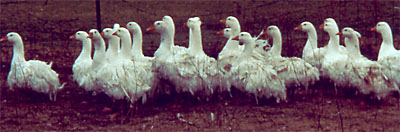
Sebastopol goose originated in southeastern Europe. While sources do not
agree on the precise location, they all point to the region around the
Black Sea. The Poultry Book, published in 1909, states that they were
named after Sebastopol, a Russian city from which they were imported (Johnson,
et. al., 1909). It was developed from the wild Graylag goose which is
native to Europe (Holderread, 1981). The American Poultry Association
recognized the breed in 1938 (Malone, et. al., 1998).
The
Sebastopol goose originated in southeastern Europe. While sources do not
agree on the precise location, they all point to the region around the
Black Sea. The Poultry Book, published in 1909, states that they were
named after Sebastopol, a Russian city from which they were imported (Johnson,
et. al., 1909). It was developed from the wild Graylag goose which is
native to Europe (Holderread, 1981). The American Poultry Association
recognized the breed in 1938 (Malone, et. al., 1998).
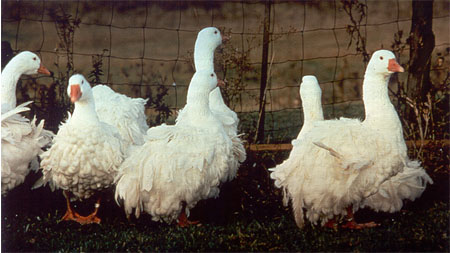
The Sebastopol is readily identified by its feathers. Long, soft-quilled, curling feathers drape elegantly from its wings, body and tail. This modification in plumage is an example of breeding for a specific trait. The white variety of the Sebastopol is best known. Both males and females have pure white feathers that contrast with their bright blue eyes and orange bills and feet. Juveniles often have traces of gray. There are also gray and buff color varieties.
 Sebastopols
are medium-sized geese, weighing 12 – 14 pounds when mature. They have
large, rounded heads, prominent eyes, slightly arched necks, keelless
breasts and dual lobes (fatty lobes that hang below the abdomen). The
plumage of the head and upper two-thirds of the neck is normal, while
that of the breast and underbody is elongated and well-curled. The soft,
fluffy feathers of the back, wings and tail have flexible shafts, are
attractively spiraled, and in good specimens are so long that they nearly
touch the ground (Holderread, 1981). The curled feathers prevent flight
making them easier to confine (Grow, 1972). Sebastopols produce 25-35
eggs annually. When handled carefully, they have a quiet and pleasant
nature (Holderread, 1981).
Sebastopols
are medium-sized geese, weighing 12 – 14 pounds when mature. They have
large, rounded heads, prominent eyes, slightly arched necks, keelless
breasts and dual lobes (fatty lobes that hang below the abdomen). The
plumage of the head and upper two-thirds of the neck is normal, while
that of the breast and underbody is elongated and well-curled. The soft,
fluffy feathers of the back, wings and tail have flexible shafts, are
attractively spiraled, and in good specimens are so long that they nearly
touch the ground (Holderread, 1981). The curled feathers prevent flight
making them easier to confine (Grow, 1972). Sebastopols produce 25-35
eggs annually. When handled carefully, they have a quiet and pleasant
nature (Holderread, 1981).
Whenever a domestic animal is selected for an unusual characteristic, great care must be taken to insure that vigor and fertility of breeding stock is not overlooked. Robust health and adequate size should be the foremost selection attributes. Secondarily, select for birds with well-curled breast feathers, flexible flight feathers, and back and tail plumes that are long, broad and spiraled. Avoid selecting breeding stock with crooked toes and slipped wings (Holderread, 1981).
To keep Sebastopols looking good, clean water for swimming should be made available. While Sebastopols are hardy and are being raised successfully in cold climates, it is a good idea to provide more protection during wet, cold, and windy weather than normally afforded other breeds, as their loose fitting feathers do not provide as much warmth, nor do they shed water as well. Ganders can be mated with one to four geese. If low fertility is experienced, clipping the long plumes of the back and tail and the feathers around the vent is sometimes helpful (Holderread, 1981). Sebastopols produce good quality meat for roasting.
Status: See CPL
Bibliography:
Bender, Marjorie; Sponenberg, D. Phillip;
Bixby, Donald. 2000. Taking Stock of Waterfowl: The results of the
American Livestock Breeds Conservancy’s Domestic Duck and Goose Census.
American Livestock Breeds Conservancy. Pittsboro, North Carolina.
Grow, Oscar. 1972. Modern Waterfowl Management and Breeding Guide.
Holderread, Dave. 1981. The Book of Geese: a Complete Guide to Raising the Home Flock. Hen House Publications.
Johnson, Willis Grant, and George O. Brown, eds. 1909. The Poultry Book. Doubleday, Page & Company. 1909.
Malone, Pat; Donnelly, Gerald; Leonard, Walt. 1998. American Standard of Perfection. American Poultry Association, Inc. Mendon, MA.
| The American Livestock Breeds Conservancy | |
PO Box 477 |
ALBC is a trademark
of American Livestock Breeds Conservancy. |
Pittsboro, North Carolina 27312 USA |
|
Telephone: 919-542-5704 |
|
Fax: 919-545-0022 |
|
|
HOME About
ALBC Breed Information Calendar ALBC
Store |
|