"...when the last individual
of a race of living things breathes no more, another Heaven and another
Earth must pass before such a one can be again."
-William Beebe
 • SEARCH ALBC
This article appeared in the September/October issue of the ALBC newsletter. ALBC members receive 6 bi-monthly newsletters that contain articles about the breeds of livestock and poultry that we work to conserve as well as the people involved in these efforts. Members also receive an annual breeders directory that provides contact information for ALBC members who have breeding stock available, as well a list of products from these breeds that they offer for sale.
Please support our work, join today!
From the July/August 2009 ALBC Newsletter:
First Settlers Return to Bermuda
By: Don Bixby
Shipwrecked
In the summer of 1609, the Sea Venture, part of a relief fleet bringing provisions to starving Virginia colonists, was blown off course by a hurricane and was shipwrecked on the shoals off Bermuda. When the 150 men, women, and children on board reached shore they found an abundance of hogs, as well as fish and exotic plants they were able to use for food. Admiral George Somers organized hunting parties that rounded up dozens of hogs at a time to feed passengers and crew while they constructed two new boats to carry them to Virginia. Somers eventually returned once more to Bermuda as a leader of the colony.
Although the hogs meant the difference between life and death for the first English people to arrive on Bermuda, swine had been on the island for nearly a century. Juan de Bermudez, captain of the ship La Garza stocked Bermuda with pigs back in 1515, expecting them to provide fresh meat for subsequent transatlantic voyagers.
Sometime after mid-1616, the recently chartered Somer Islands Company began to supply its colony with small coins, the first currency minted in an overseas territory. The coins were used to buy goods at the company storehouse. The image of a ship—an evocative symbol for all who had made the perilous voyage to Bermuda—appeared on one side. Stamped on the other side was a symbol equally meaningful to these early settlers: a picture of a hog. These new coins came to be known as "hogge money." Influential as these pigs were to the economy of Bermuda they did not long survive the appetites of the colonists and were probably extinct as early as 1620.
Fast-forward to the early 20th Century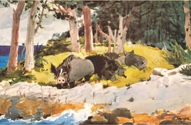
The celebrated American artist, Winslow Homer, visited Bermuda in 1899 and 1901. He captured local images in a series of 22 captivating water-colors. He was especially taken by the legend of the Bermuda hogs. Homer depicted the first European "settlers" to the islands of Bermuda as an imaginary herd of pigs in a native cedar grove. Homer’s watercolor was featured on a Bermuda postage stamp in 1987. (Image: First Settlers watercolor by Winslow Homer circa 1901)
The 21st Century
At a conference in Bermuda in 2006, the author met American Livestock Breeds Conservancy member Tom Wadson at the Saturday City Farmers’ Market in Hamilton. Known to many as the Green Giant, Farmer Tom grows everything from avocados to zucchini on his 35 acres of farmland in Southampton. He was the recipient of the 2008 Award of Excellence for his support of sustainable agriculture and responsible cuisine. What started as a small, two-acre farming operation in the late 1970s has grown into a major business that now produces organically grown fruit and vegetables, eggs, chickens, and lamb. Wadson’s products are available 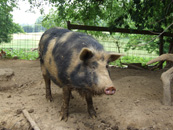 on Saturday mornings at the City Farmers’ Market, in many major grocery stores and in several of Bermuda’s finest restaurants. An invitation to visit the farm was delightedly accepted and the next day my wife and I took the bus out to the farm for a tour and lots of conversation. I suggested that though the Bermuda hogs were long gone, Ossabaw Island hogs were likely of the same genetic and geographic origin, since the Ossabaw swine population was also established by Spanish and Portuguese adventurers, and were already adapted over the centuries for island living.
While most feral pigs eventually mixed with domestic pigs, Ossabaw Island animals remained distinct as a result of their isolation, closely reflecting their Spanish heritage. As the pigs adapted to Ossabaw Island, they became smaller, a process called insular dwarfism. They also adapted to the food cycle on Ossabaw, which is very restricted during the spring season. They evolved a system of fat metabolism that enabled them to store a larger proportion of fat than any other hog. In conjunction with this, they have a form of low-grade, non-insulin dependent diabetes, making them useful research animals. Ossabaw Island was gifted to the nation and designated as the State of Georgia’s first heritage preserve in 1978. The island has been dedicated to conservation and education, and perhaps can continue to serve as a sanctuary for this unique breed of swine.
With no further encouragement, Tom followed up on my bit of information and has succeeded in re-establishing an historic population of adapted Ibero-American hogs in Bermuda. The Bermuda hogs “immigrated” from the conservation herd at Historic Mount Vernon. They are doing well and two have been butchered and declared succulent. Ten more are growing like weeds and two others are pregnant. These pigs are proving a hit with the 400th anniversary celebration in Bermuda. The pigs will probably be featured in an exhibit at he Bermuda Aquarium and Zoo as well as on the menus of those celebrating 400 years of Bermuda history. Tom’s effort should be celebrated as a conservation success because it establishes a breeding population of an American breed abroad that is both historically and genetically appropriate.
Note: There is historic agreement that Ossabaw Island hogs have descended from foundation stock brought by Spanish explorers, inferring that the pigs are Spanish in origin. Recent DNA analysis suggests that the Ossabaw Island pigs came from the Canary Islands, an important stop by the Spanish and Portuguese explorers en route to the New World. The mitochonidrial DNA of Spanish (or Iberian) pigs reflects only European influences, whereas the mtDNA of pigs on the Canary Islands reflects the influence of Asian pigs. The mtDNA of the Ossabaw Island pigs is more like that of the pigs on the Canary Islands than the Iberian. Additional genetic research is needed to understand the relationship of the pigs on Canary Islands and on Ossabaw Island with Spanish pigs. For more information about this finding, look in the next issue of the ALBC News.
The author acknowledges the fascinating account of the return of the “first Settlers” in the Bermudian by Dr. Edward Harris, Executive Director of the Bermuda Maritime Museum.
Dr. Don Bixby explores the histories and characteristics of rare breeds of livestock and poultry from the Eastern Continental Divide in Blacksburg, Virginia. [email protected]
For more information about Tom Wadson’s farm, contact: Wadson’s Farm, 10 Lukes Pond Rd, PO Box SN528, Southampton SN BX, Bermuda, (441) 238-1862, [email protected].
| The American Livestock Breeds Conservancy | |
PO Box 477 |
ALBC is a trademark
of American Livestock Breeds Conservancy. |
Pittsboro, North Carolina 27312 USA |
|
Telephone: 919-542-5704 |
|
Fax: 919-545-0022 |
|
|
HOME About
ALBC Breed Information Calendar ALBC
Store |
|