"...when the last individual
of a race of living things breathes no more, another Heaven and another
Earth must pass before such a one can be again."
-William Beebe
 • SEARCH ALBC
ALBC News Sample Article: March/April 2011
Changes to the 2011 Conservation Priority List
Each year, ALBC releases its annual Conservation Priority List (CPL) which provides  an assessment of endangered breed populations for domestic livestock and poultry breeds throughout the United States. Because these populations are continuously changing, the CPL is one of the primary tools for monitoring and evaluating breed populations.
For 2011, only a few changes were made to the CPL.
In the poultry category, the Buckeye chicken has been moved from Critical to Threatened based on 2010 census data gathered by ALBC (with the help of the two Buckeye clubs) which found nearly 2,500 breeding birds in the global population with the majority of these birds in the United States.
In 2005, ALBC began the Buckeye Conservation Project to see if a rare breed of chicken could be brought back to historic levels of productivity using time-honored selection methods that have largely been lost. Over the course of several years, chicks were hatched and continuously selected, breeders were engaged, clubs were formed, and awareness of the breed spread. The advancement of the Buckeye’s conservation status is a testament to all the hard work of the Buckeye chicken community.
Another change in the poultry category is the recognition of the White Holland turkey as an American breed. The change was made with many supportive historic accounts and evidence (provided by Master Turkey Breeder, Frank Reese) that points to the White Holland as being developed in the United States from white sports of the Bronze variety. Although there were white turkeys being bred in Holland and Europe in the 18th century, it appears that these did not contribute to the development of the modern White Holland variety found in the United States.
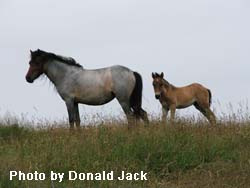 In the livestock section, the Newfoundland Pony was added to the Study category. In the 1970s, there were about 12,000 Newfoundland Ponies: by the 1980s, the population had diminished to a few hundred as many were sold for meat in European markets. According to the Newfoundland Pony Society, there are currently fewer than 400 Newfoundland Ponies with only about 250 breeding animals – the rest being geldings or individuals too old for breeding.
Newfoundland Ponies have been on the large Canadian island of Newfoundland since the 17th and 18th centuries. They developed into a unique breed superbly adapted to the cool, wet, maritime climate of the area. It is thought that the foundation stock of this breed comprises a number of pony breeds including Exmoor, Dartmoor, New Forest, and may also have had influence from Welsh Mountain, Galloway (extinct), Highland, and Connemara Ponies. As of March 2010, the Newfoundland Pony Society is seeking “Purebred Status” in Canada under the Animal Pedigree Act. They are currently regarded as an “Evolving Breed” by Canada. A formal written standard and breeding plan are being developed for the breed by the Society. In the United States there are small pockets of horses, primarily in northern states.
The goal of the CPL is to take a snap-shot of a breed’s population at a given point in time. This information helps drive conservation priorities for endangered breeds and helps raise public awareness about the need for domestic livestock conservation in the United States.
For 2011, there are 188 breeds of livestock and poultry on the Conservation Priority List. Thirty-three mammalian breeds and 29 poultry breeds are listed as critically endangered.
For more information about the changes to the Conservation Priority List, contact [email protected] or call (919) 542-5704.
| The American Livestock Breeds Conservancy | |
PO Box 477 |
ALBC is a trademark
of American Livestock Breeds Conservancy. |
Pittsboro, North Carolina 27312 USA |
|
Telephone: 919-542-5704 |
|
Fax: 919-545-0022 |
|
|
HOME About
ALBC Breed Information Calendar ALBC
Store |
|