"...when the last individual
of a race of living things breathes no more, another Heaven and another
Earth must pass before such a one can be again."
-William Beebe
 • SEARCH ALBC
This article appeared in the May/June 2010 issue of the ALBC newsletter. ALBC members receive 6 bi-monthly newsletters that contain articles about the breeds of livestock and poultry that we work to conserve as well as the people involved in these efforts. Members also receive an annual breeders directory that provides contact information for ALBC members who have breeding stock available, as well a list of products from these breeds that they offer for sale.
Please support our work, join today!
From the May/June 2010 ALBC Newsletter:
Linebreeding: A Practical Application
By Richard Larson 
In their excellent book, A Conservation Breeding Handbook, Sponenberg and Christman state, “conservation breeding requires the breeder to break away from the usual practices and rewards of animal breeding and instead draw satisfaction from working for the long-term good of a rare breed.”1
Our introduction to rare breeds came in 1992 when Donna and I acquired a Karakul ram and two ewes. For the next several years, we randomly added stock to our flock from various flocks, even traveling to Canada to import two rams and two ewes. Although we didn’t recognize it at the time, our first lucky break came in 1996 when we had an opportunity to select from a flock that had been essentially “closed” for more than 25 years. The uniformity of those ewes was striking. Even more impressive to us novice conservation breeders was the consistency of conformation, fleece, and breed characteristics of their lambs.
Our second lucky opportunity came when we were fortunate to acquire the Ponte Karakul flock from California. This flock had been “closed” for over 40 years. I will never forget the striking beauty and uniformity of this marvelous flock as they arrived at our farm. It was about this time that I first read about line-breeding in A Conservation Breeding Handbook. “The strength of linebreeding is that it narrows the range of variation, making the resulting population more uniform and therefore more predictable. Purebred animal breeding frequently has this as one of its goals: a uniform, predictable, high quality flock.”2 The book also notes,“if the goal is an excellent flock with high predictability and decreased variability, the choice should include some linebreeding. This generally implies a long term commitment to a specific bloodline within a breed and can produce excellent long-term results.” 3
Almost a decade into rare breed conservation, we had, for the first time, a breeding philosophy. Why was that important? “A basic and guiding philosophy is the single most critical component of any breeding program. A philosophy of breeding combines the elements of genetics, selection, and husbandry to accomplish a goal. If a philosophy is in place, every animal and every mating can be evaluated relative to the goal, giving purpose and identity to the flock. The philosophy of conservation breeding has as its objective the management of a breed as a genetic resource for the future.”4
Applying this linebreeding philosophy to our Leicester Longwool flock presented some different challenges. To understand these challenges, let’s begin by reviewing the modern history of Leicester Longwool sheep in the United States.
In 1990, Colonial Williamsburg imported 16 Leicester Longwool from Tasmania, Australia. Two additional Leicester Longwools went to a Pennsylvania farm. These 18 sheep that comprised the U.S. foundation flock came from four Tasmanian flocks – Connaughtville, Glenhu, Marengo and Melton Vale. Initial breeding programs following the importation focused on developing the broadest possible genetic base for the breed in the United States. In the late 1990s, breeders began using semen imported from three New Zealand flocks – Beechwood, Ravenswood, and Riverside. The principal objective of using imported semen from flocks not related to the four flocks of the original importation stock was to further broaden the genetic base of U.S. Leicester Longwools.
After experiencing first-hand the long-term benefits of linebreeding with our Karakul, we were eager to establish a linebreeding program with our Leicester Longwool flock. Unlike our Karakuls that had benefited from long-established breeding programs by earlier breeders, with our Leicester Longwools we had to develop our own linebreeding plan. Upon reviewing the history of the original importations and the subsequent importation of semen, we concluded that the most feasible option for developing Leicester Longwool bloodlines in the United States was to build them around three distinct sources (flocks) of imported semen.
Colonial Williamsburg aided us in our efforts to establish our linebreeding program by allowing us to acquire ram lambs from their breeding program. The ram lambs we received were sired using semen from the three New Zealand flocks – Beechwood, Ravenswood, and Riverside. Next we categorized each of our ewes into the most appropriate breeding group corresponding to the three New Zealand flocks. Fortunately, because this same semen had been used several years earlier at Colonial Williamsburg, the genetics from the ram lambs was prevalent in the pedigrees of most of our ewes. “The conservation breeding program begins with an evaluation of the relatedness of the [flock] population and the division of animals into three groups that are more closely related to each other than to the [flock] as a whole.”5
The results of our pedigree review yielded 13 ewes with Beechwood genetics, 7 ewes with Ravenswood genetics, and only 3 ewes with Riverside genetics. Some of our ewes traced back to two or all three of the New Zealand rams. So our third step was to re-sort the duplicate ewes which yielded a much more equitable distribution – 7 Beechwood, 6 Ravenswood, and 3 Riverside ewes per breeding group.
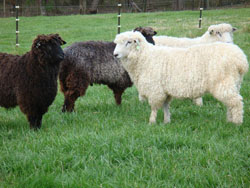 Our fourth step was to mate each of the three AI-sired rams with their corresponding ewe group. The 7 ewes in our Beechwood group were bred to our Beechwood ram, the 6 ewes in our Ravenswood group were bred to our Ravenswood ram, and the 3 Riverside ewes were bred to our Riverside ram. In an effort to broaden our genetic pool within each breeding group, from this initial mating and in successive matings, we select two or three ram lambs from each breeding group to grow out as possible future flock rams. Several years after developing and implementing our breeding philosophy for three distinct Leicester Longwool bloodlines, we are beginning to see the fruits of our linebreeding efforts.
While developing and maintaining distinct bloodlines is relatively straight forward, there are practical considerations that one needs to consider.
First, you have to have an adequate flock size. Sponenberg and Christman suggest a minimum of ten females per line. In our case, we were slightly smaller in two lines and our Riverside line was much smaller with our three original ewes. Our business plan is to maintain a flock of 30 ewes so over the long-term we will have an adequate size flock to accomplish our three bloodlines objective.
Second, pursuing a linebreeding philosophy requires a disproportionate number of males. “The most dramatic management change required by the conservation philosophy is the selection and use of a relatively large number of individuals (particularly males) for breeding. This is particularly the case in conservation breeding programs, where more males are used over a shorter time than is typical of ordinary breeding programs.”6 With our flock of 30 ewes we continually maintain between 10 and 12 adult flock rams. In addition, each year we grow out between six and nine ram lambs to evaluate as potential breeding rams.
Third, one must be prepared to cull vigorously. All sheep have at least one weak or undesirable trait. When linebreeding these weak points will randomly appear in individual lambs. These individuals must be culled from the flock. Strict adherence to vigorous culling will, over time, serve to reinforce the desirable traits in a bloodline and diminish the weak points – outcomes that are highly desirable for both the flock and the breed.
Why invest the time and effort to develop specific bloodlines? The short-term answer is greater confidence. Through managed linebreeding we are able to offer our customers greater assurance that the sheep they are buying from will reproduce predictably. For example, a breeder looking for a flock ram to enhance characteristics in his flock such as fleeces, quality, conformation, size, and/or breed character can select one of our rams that has the qualities he desires. Because the ram selected is a product of linebreeding, the buyer and I can have greater confidence that the ram they are purchasing will move his flock in the desired direction. Similarly, a buyer selecting their Leicester Longwool starter flock from us can have confidence that their lambs next year and every year after will be the same quality as represented in their initial flock.
Our longer-term answer is quite simply that it enables us to draw satisfaction from working for the long-term good of a rare breed. It is rewarding to be able to linebreed these three old lines of Leicester Longwool sheep and to be able to encourage others to select other lines for similar attention.
1D. Phillip Sponenberg & Carolyn J. Christman, A Conservation Breeding Handbook (1995).
2 Id. at 27.
3 Id. at 29.
4 Id. at 11.
5 Id. at 79.
6 Id. at 12 and 19.
Richard and Donna Larson raise Leicester Longwool sheep, Milking Devon cattle, and several rare breeds of chickens at Old Gjerpen Farm. They may be reached at 10042 Cedar Spring Lane, Culpeper VA 27701,(540)829-5683, www.oldgjerpenfarm.com.
A Conservation Breeding Handbook by D. Phillip Sponenberg and Carolyn J. Christman is available for $15.95 through the ALBC store. You can visit the store online at www.albc-usa.org, or you can call the office to place an order, (919) 542-5704.
For more information about Leicester Longwool sheep, contact the Leicester Longwool Sheep Breeders Association, Joan Henry – Secretary/Treasurer, Rural Rt 1, Box 172 B, Albright, WV 26519, (304)379-9100, [email protected], www.leicesterlongwool.org.
| The American Livestock Breeds Conservancy | |
PO Box 477 |
ALBC is a trademark
of American Livestock Breeds Conservancy. |
Pittsboro, North Carolina 27312 USA |
|
Telephone: 919-542-5704 |
|
Fax: 919-545-0022 |
|
|
HOME About
ALBC Breed Information Calendar ALBC
Store |
|