"...when the last individual
of a race of living things breathes no more, another Heaven and another
Earth must pass before such a one can be again."
-William Beebe
 • SEARCH ALBC
This article appeared in the September/October issue of the ALBC newsletter. ALBC members receive 6 bi-monthly newsletters that contain articles about the breeds of livestock and poultry that we work to conserve as well as the people involved in these efforts. Members also receive an annual breeders directory that provides contact information for ALBC members who have breeding stock available, as well a list of products from these breeds that they offer for sale.
Please support our work, join today!
From the September/October 2008 ALBC Newsletter:
Highland Cattle, a Conservation Success
by Gloria Asmussen
 Editor’s note: Highland cattle are a conservation success story. Efforts of breeders worldwide have brought this breed back to healthy population levels. ALBC hopes that this article and the associated article Highland Promotions will inspire breeders of critically rare breeds, and that some of the strategies that have succeeded for Highland cattle can be adapted to help other breeds succeed as well.
 People unfamiliar with Highland cattle often mistake them for buffalo, which they are not. Highlands are docile, hardy cattle with outstanding meat quality: low in fat and cholesterol and high in iron and protein.
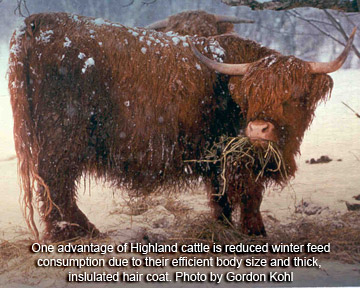
These cattle have a double coat of hair – a long, coarse outer layer and a soft, wooly inner layer. This unique coat reduces need for shelter. Long hair over the eyes reduces the incidence of pinkeye and other fly-borne diseases. According to one breeder, Highlands winter feed intake does not increase until outdoor temperatures dip below -18ºF, this compares to 32ºF for many other breeds. The long hair means that the animal does not have to produce a layer of fat to stay warm. This allows its meat to marble naturally on low input forage – producing lean, high quality beef.
Historically, Highland cattle evolved in the harsh climate of Scotland. Archeological evidence of the breed dates to the 6th century, with written records existing from the 1300s. Early Scots would keep the cows downstairs in their homes to generate warmth for the family, which lived above on the second floor. The cattle are easy to handle despite their long horns, which they use primarily for knocking down brush (for grazing), predator control, and scratching themselves. They are excellent foragers and eat many plants that other breeds reject. They can clean out the underbrush in a woodlot: roses, buck brush, ragweed, many different tree leaves, cedar saplings, pine needles, and cattails. Highlands never go hungry.
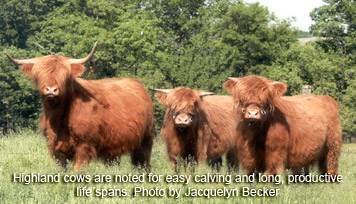
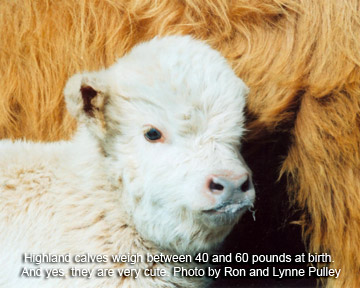 Highland cows weigh 900-1200 pounds when mature and calve with ease, producing 40-60 pound calves. They often produce into their late teens, reducing the need for frequent herd replacements. Highland bulls average 1500-2000 pounds, depending on foraging conditions.
Highland cattle mature slowly, making their meat fine-textured and succulent. The breed fits into a variety of settings: homesteads, small farms, and commercial operations. They can also be trained as oxen.
Twenty years ago the American Livestock Breeds Conservancy listed Highland cattle as an endangered breed. The recovery of the Highland is attributed to the promotion of the breed. There are now over 45,000 registered animals and almost 1,500 breeders. And there are thousands more unregistered Highlands in the United States.
Highland breeders promote the breed at farm-related events such as seminars, heritage festivals, county fairs, cattle shows and Scottish festivals. Last November a representative of the Heartland Highland Cattle Association showed cattle and spoke of the breed at the Small Farm Today conference in Columbia, Missouri. Many breeders offer samples of their Highland meat at events, stores, and restaurants; some have recipe cook-offs and tastings. One breeder takes a concession trailer to Scottish festivals and sells Highland burgers. Another created the original “Highland Coo Sandwich,” popular at local events.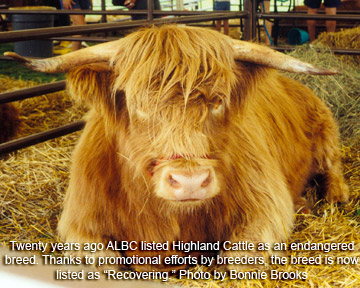
This year Ayrshire Farm in Upperville, Virginia hosted the American Highland Cattle Convention. Ayrshire Farm, a member of ALBC and AHCA, is dedicated to conserving rare breeds. The conference included workshops on marketing Highland cattle as well as tours of Ayrshire Farm’s processing and retail ventures. It is in venues such as this, as well as the newsletter, The Bagpipe, that breeders share tips to better promote this wonderful breed.
Gloria Asmussen is Executive Secretary for the Heartland Highland Cattle Association (HHCA). This is a regional association formed in 1994 in Missouri with the goal of promoting the Highland Cattle Breed. The HHCA is an affiliate of the American Highland Cattle Association. HHCA sends out a free educational packet to anyone interested in learning more. Contact: HHCA, 976 State Hwy. 64, Tunas, MO 65764, (417) 345-0575, visit www.heartlandhighlandcattleassociation.org, or email [email protected].
American Highland Cattle Association, Historic City Hall, 22 S 4th Ave, Suite 201, Brighton, CO 80601-2030, (303) 659-2399, e-mail: [email protected], web: www.highlandcattleusa.org
| The American Livestock Breeds Conservancy | |
PO Box 477 |
ALBC is a trademark
of American Livestock Breeds Conservancy. |
Pittsboro, North Carolina 27312 USA |
|
Telephone: 919-542-5704 |
|
Fax: 919-545-0022 |
|
|
HOME About
ALBC Breed Information Calendar ALBC
Store |
|