"...when the last individual
of a race of living things breathes no more, another Heaven and another
Earth must pass before such a one can be again."
-William Beebe
 • SEARCH ALBC
Belted Galloway Cattle
Galloway cattle originated in the rugged hill country of southwestern Scotland. The native cattle of this region were consistently hardy and thrifty, though they varied in color, conformation, and horn ty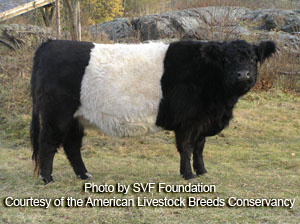 pe. During the late 1700s and early 1800s, the Galloway breed was developed through selection for more standardized, polled beef cattle that retained environmental adaptation. Galloways came to be celebrated for their efficiency on rough forage, maternal ability, and high quality beef. A herdbook was established in 1877.
Most Galloway cattle are black, but several other colors are also found in the breed. The most distinctive is black with a white belt. A separate herd book for belted cattle was established in Scotland in 1928, and this division of the strains by color has led to the formation of the Belted Galloway breed. This breed remains very similar to the Galloway, however, and shares most of its other characteristics.
The origin of the belted color pattern is not clear. This pattern occurs in several breeds found in different places, most notably in the Laken velder breed in the Netherlands (called the Dutch Belted in North America). The belted pattern has been selected against and has disappeared in some breeds, such as the Welsh Black and the Kerry. In the Belted Galloway, however, the belted pattern has been fostered as the standard for all animals of the breed.
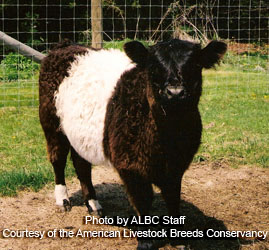 Beneath the flashy appearance is found a very useful animal. The Belted Galloway is well adapted to cold, rugged climates; as part of this adaptation, the cattle grow a shaggy hair coat in the winter. In the summer, Belted Galloways shed this coat and tolerate warm climates better than do most other cold adapted cattle. Galloways are medium in size, with cows weighing about 1,000 pounds and bulls about 1,600 pounds Cows show strong maternal instinct, including the ability to protect calves against predators.
Belted Galloway beef, like that from Galloways and other Scottish breeds, is of high quality and can be marketed in a variety of specialty niches, including grass fed and organic beef. The long body conformation increases the production of high priced cuts of beef. Hides may be used to make rugs, and the belting pattern combined with the shaggy hair makes these products distinctive and attractive.
Belted Galloways were imported to North America beginning in the 1940s, and the Belted Galloway Society in the United States was founded in 1951. The breed is increasing in numbers in North America and globally. In Europe the breed is considered a “light grazer,” meaning that its relatively light body weight makes it preferred for grazing where heavier animals would damage marginal lands. Belted Galloways are also known for browsing ability, giving them added value in the management and diversification of grasslands.
Status: See CPL
Breed clubs and associations:
American Livestock Breeds Conservancy, PO Box 477, Pittsboro, NC, 27312, (919) 542-5704, [email protected], www.albc-usa.org
Belted Galloway Society, N8603 Zentner Rd, New Glarius, WI 53574, (608) 220-1091, [email protected], www.beltie.org
| The American Livestock Breeds Conservancy | |
PO Box 477 |
ALBC is a trademark
of American Livestock Breeds Conservancy. |
Pittsboro, North Carolina 27312 USA |
|
Telephone: 919-542-5704 |
|
Fax: 919-545-0022 |
|
|
HOME About
ALBC Breed Information Calendar ALBC
Store |
|