"...when the last individual
of a race of living things breathes no more, another Heaven and another
Earth must pass before such a one can be again."
-William Beebe
 • SEARCH ALBC
Fell Pony
 The
Fell Pony is one of five native pony breeds of England, the others being
the Dales, Dartmoor, Exmoor and New Forest. These breeds descend from
the ancient Celtic horses of northern Europe that had migrated to the
British Isles. The Fell originated in the uplands of northern England
where they were used as pack animals for the lead-mining industry on the
western slopes of the Pennines. (Their close cousin, the Dales Pony, was
used on the eastern slopes.) Until the 1800s, this hardy pony carried
loads of lead ore down to the coast from the mines, then returned carrying
coal, traveling 200 miles per week over rocky, rugged terrain.
The
Fell Pony is one of five native pony breeds of England, the others being
the Dales, Dartmoor, Exmoor and New Forest. These breeds descend from
the ancient Celtic horses of northern Europe that had migrated to the
British Isles. The Fell originated in the uplands of northern England
where they were used as pack animals for the lead-mining industry on the
western slopes of the Pennines. (Their close cousin, the Dales Pony, was
used on the eastern slopes.) Until the 1800s, this hardy pony carried
loads of lead ore down to the coast from the mines, then returned carrying
coal, traveling 200 miles per week over rocky, rugged terrain.
The early ancestry of the Fell is obscure. Its lineage is thought to include
the now-extinct Scottish Galloway and Friesian stocks imported from the
Netherlands by the Romans during the 2nd century AD. These ponies survived
on the rugged hills, or fells, of Britain. As the mining industry turned
to the railroad for transportation the Fell Pony found new employment
on the hill farms as a small draft animal. It was used in the field, for
transportation, for herding sheep and for pleasure. As carriage driving
became popular, Yorkshire and Norfolk Trotter blood was introduced. A
popular Welsh Cob stallion was used as well. With the advent of gasoline
powered engines, the Fell Pony lost most of its jobs which led to the
breed’s dramatic decline to dangerously low numbers.
Today the breed is utilized for trekking (a northern English term describing
cross-country riding on an easy-moving, comfortable animal), jumping and
in driving competitions.
Most Fells are still bred in the north of Great Britain, and a few breeders
maintain their ponies in the traditional way in loose, wide-roaming herds
on the fells. The pony has seen some resurgence in popularity in the last 20 years, as breeders in Europe and North America have found value in these versatile ponies.
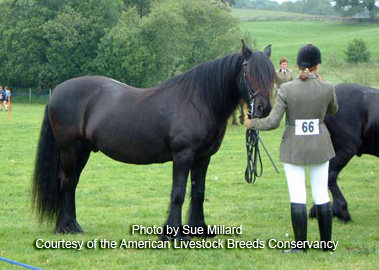
The Fell Pony stands 13-14 hands (52 – 56”) at the withers,
and is smaller and lighter than the Dales pony, to whom it is closely
related. While primarily solid black, its dense coat may also be bay,
brown or gray. White is permissible only as a small star or below the
hind fetlocks. It has feathered fetlocks, and a heavy mane and tail. Its
sturdy, well muscled legs, large strong cannon bones and strong, broad
feet contribute to its surefootedness and stamina. This thrifty pony can
live off the sparse vegetation of the fells.
Status: See CPL
| The American Livestock Breeds Conservancy | |
PO Box 477 |
ALBC is a trademark
of American Livestock Breeds Conservancy. |
Pittsboro, North Carolina 27312 USA |
|
Telephone: 919-542-5704 |
|
Fax: 919-545-0022 |
|
|
HOME About
ALBC Breed Information Calendar ALBC
Store |
|