"...when the last individual
of a race of living things breathes no more, another Heaven and another
Earth must pass before such a one can be again."
-William Beebe
 • SEARCH ALBC
Kerry Cattle
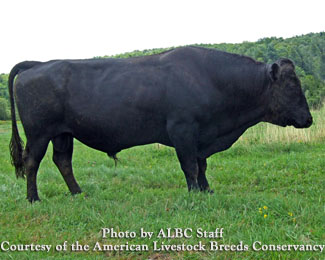 Kerry cattle are indigenous to Ireland and are one of the oldest European breeds of cattle. The breed gets its name from the county of Kerry where it was widely popular. The Kerry descends from the ancient, fine-boned, black Celtic cattle that occupied this area at the time of Caesar’s invasion of Britain.
According to the Irish Cattle Breeding Federation, prior to the 17th century the breed was one of the most prevalent in Ireland but was little known outside of its native land. The importation of other cattle breeds and crossbreeding during the 1800’s led to a population decline of the Kerry breed in their native land. Kerry cattle were isolated in the impoverished southwestern regions of Ireland, where the breed’s ability to thrive and grow on meager forage under harsh conditions made it an important asset to poor farmers.
- Kerry cattle were first imported into the United States in 1818, coming ashore in Pennsylvania. The breed never became widely popular in the U.S., but a small population exists today from re-importations of cattle and semen beginning in the 1960s. The breed is considered globally rare, and the population in North America could help to re-establish the breed if some disaster should occur to the larger population in Ireland and the U.K. North American Kerry breeders are working with the Kerry Cattle Society in Ireland, who registers stock, to conserve these rare cattle.
Closely related to Kerry cattle, the Dexter is a small, dual-purpose breed that originated from the same ancestral stock. Through the early nineteenth century both Kerry and Dexter cattle were produced from the same herds, and were registered in the same herdbook. The taller, heavier animals were registered as Kerry, while the shorter stockier animals were registered as Dexter. Surprisingly, blood-typing has established that the two breeds are now genetically distinct. They should not be crossed with each other.
Kerry cattle are solid black with a small amount of white allowed on the underline. They are small and lean, with cows averaging 800 pounds and bulls 1,000 pounds. The cattle are fine boned with delicate heads and upswept, lyre-shaped white horns with black tips. They are active grazers and browsers, hardy and long-lived, often continuing to be productive milking cattle into their teens. Kerry cows are robust mothers that have little to no difficulty calving. They produce an average of 5000 – 7000 pounds of milk in a lactation period although there are a number of cows capable of yielding over 10,000 pounds. The globules of butterfat in the milk are smaller than those from most dairy breeds, making the milk more easily digestible by people. Kerry milk is also particularly well suited for cheese production. Although a good fit for small farms, the active nature of Kerry cattle makes them best suited for experienced cattle farmers.
Status: See CPL
| The American Livestock Breeds Conservancy | |
PO Box 477 |
ALBC is a trademark
of American Livestock Breeds Conservancy. |
Pittsboro, North Carolina 27312 USA |
|
Telephone: 919-542-5704 |
|
Fax: 919-545-0022 |
|
|
HOME About
ALBC Breed Information Calendar ALBC
Store |
|