"...when the last individual
of a race of living things breathes no more, another Heaven and another
Earth must pass before such a one can be again."
-William Beebe
 • SEARCH ALBC
Dutch Hookbill Duck
This unique and very old Dutch breed of duck is thought to have originated in the Netherlands between the seventeenth and eighteenth centuries in the province of Noord-Holland. As the name implies, the breed is characterized by its downward curving beak setting it apart from other duck breeds. It is believed that this trait was particularly useful to duck breeders in Holland since their beaks made it easier for hunters to distinguish Hookbills from wild ducks that inhabited the same areas as the domesticated birds. In Holland these ducks were managed in the waterways and canals of the countryside and they were expected to forage for most of their food on their own. Today they are still among the best foragers of domestic ducks. 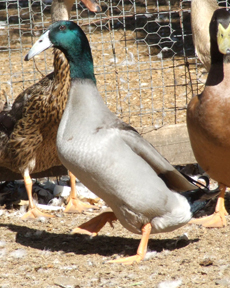 According to the Dutch Association of Breeders of Domesticated Waterfowl (Nederlandse Vereniging van fokkers van gedomesticeerd watervogels) the Hookbill duck and the Noord-Holland White Breasted duck (also known as the Witborst duck) had similar genealogies. Their exact origin has never been determined but it is speculated that the breeds developed from early importations of Indian Runners. This idea is supported by J. Bonenkamp in the magazine Avicultura (8/1990) where he accounts of finding pure Hookbill ducks among groups of ducks in East India.
The unique appearance of the Hookbill made them desirable as ornamental birds but early on the Hookbill was known for being excellent layers of eggs. That combined with their remarkable foraging capability made the breed widely popular on Dutch farms. The Dutch Association of Breeders of Domesticated Waterfowl (Nederlands Vereniging Van Fokkers Van Gedomesticeerd Watervogels) recounted the historic management of the breed in Holland in a 2009 article. In it they write that the ducks were historically broody and once ducklings were hatched, they were sexed and the drakes were disposed of. The remaining ducklings were marked on their bills and webs of their feet to identify the farm they belong to. The ducklings wings were clipped so they could be recaptured more easily by their owners. Then the birds were distributed back to the mother ducks which got approximately 14-15 babies each to tend to. Following this, both ducks and ducklings were all sent out to the surrounding wetlands to forage for their own food and received no further supplemental food from their owners at this point. By mid-August the birds were collected up and sent to market in Purmerend and purchased by duck keepers who would use them for egg production. The birds kept for breeding were selected to be sturdy and disease resistant, self-sufficient, adaptable to new circumstances, and efficient layers needing less food than other breeds in order to be productive. The breed declined in the 20th century due to a diminished market for duck eggs and the effect of increasingly polluted waterways that served as their home. By 1980 the Hookbill was nearly extinct but through a Dutch effort lead by Hans van de Zaan, the last 15 birds were collected and used to start a conservation breeding program in the Netherlands.
Dave Holderread was among the first to import the Dutch Hookbill into the United States in 2000. Dave found that there were three bill types in the population: extreme curve, moderate curve, and straight. In his book Storey’s Guide to Raising Ducks (2011) Dave outlines that the most effective breeding strategy was to cross birds with moderately curved beaks to each other or an extremely curved beaked bird with a straight beaked bird as the best breeding options. He found that crossing two birds with extreme curved beaks produced poor fertility in the eggs. After these two discoveries with the breed, his hatching success with Hookbills increased dramatically. To date Dave has sold thousands across the US but there are still very few people that raise them in numbers.
An important thing to keep in mind with the Dutch Hookbill is that these ducks still have flight capability if kept in good trim condition, especially younger individuals. The birds reach sexual maturity very quickly by around 16 weeks of age. Healthy ducks can be expected to lay anywhere from 100 – 225+ eggs per year. They come in three primary color variations: the dusky, the white, and the white bibbed dusky. Other colors exist but not in great numbers here in the US. The Hookbill is a remarkable breed that deserves a second look as a viable and efficient egg producer for small scale farming.
Status: See CPL
| The American Livestock Breeds Conservancy | |
PO Box 477 |
ALBC is a trademark
of American Livestock Breeds Conservancy. |
Pittsboro, North Carolina 27312 USA |
|
Telephone: 919-542-5704 |
|
Fax: 919-545-0022 |
|
|
HOME About
ALBC Breed Information Calendar ALBC
Store |
|