"...when the last individual
of a race of living things breathes no more, another Heaven and another
Earth must pass before such a one can be again."
-William Beebe
 • SEARCH ALBC
ALBC News Sample Article: May/June 2012
The Bard and the Breeds
The Bard and the Breeds
By: Katie Walker
 Arguably the greatest English poet and playwright of all time, William Shakespeare was born on or near April 23, 1564, and his birthday is a time of celebrating the Bard’s literary achievements. Although scholars and lovers of Shakespeare’s works recently celebrated this date around the globe, members of the American Livestock Breeds Conservancy also have reason to note Shakespeare’s influence on culture. What does Shakespeare have to do with rare breeds? Shakespeare lived in a culture in which many people’s livelihoods depended on cattle, equine, poultry, goats, and sheep. Interestingly, many of the breeds that Shakespeare would have known are now among our heritage breeds! Sheep and cattle in particular were so entwined in Shakespeare’s life that his plays and other texts from the seventeenth century abound in references to them.
Shakespeare’s father, John Shakespeare, was a glover, which means that he needed sheep and cattle for the leather of his fine-quality gloves. John Shakespeare was also a whittawer, or someone who made saddles and harnesses. Thus, Shakespeare would have grown up helping his father select and utilize livestock for his family’s wellbeing. English diet and medicines also consisted of many dishes or recipes made with products from animals now recognized as rare breeds. One medicinal recipe from the work The Queen’s Closet, a work often reprinted in the seventeenth century, calls for “a bottle of new milk from a red cow” to be mixed withcurrants, raisins, figs, and spearmint to cure consumption, or what we now recognize as the disease tuberculosis. Most likely, this “red cow” refers to Devon cattle (what we now call the Milking Devon), which were -present in England when Roman soldiers invaded in 55 BC and were brought to America in 1623. The availability of these cattle near the ports of departure from England to the Americas made this a favored breed for transport. Devon cattle were praised for their hardiness and practicality. Perhaps this breed was used in medical recipes as a way to make an ill body “hearty” as well. Devons were especially well regarded as the quickest and most active oxen in the British Isles, and are still known as excellent oxen today. Shakespeare likely ate meat from Devons, and would have used these cattle for leather, medicine, and transport.
Shakespeare’s plays and poems have numerous examples of sheep-coting, sheep-shearing, and land enclosure. In the play The Winter’s Tale, the beautiful princess Perdita, who has been secretly raised as a shepherdess, takes part in the community gathering for a sheep-shearing festival, emphasizing the importance of shared collaboration in an agrarian culture. A shepherd welcomes his neighbors by saying, “Come on, and bid us welcome to your sheepshearing, as your good flack shall prosper” (4.4.68-70 indicating that all aspects of sheep-raising and the production of wool and meat for the community were an integral component of their daily lives. Perhaps Shakespeare was thinking of the Cotswold sheep for his shearing festival, which was a popular and well-praised breed during Shakespeare’s time. Samuel Clarke, author of the 1657 book A Geographicall Description of all the Countries in the Known World, describes the profitability and popularity of this breed: “The wooll of England is excellent fine, especially that of Cotswold in Glocester shire.” Clarke goes on to describe how King Edward IV gave some of these sheep to the King of Castile in 1465, thus demonstrating how valuable these sheep were as gifts between English and Spanish kings. (Unfortunately, Cotswold sheep are now endangered in Great Britain as well as the United States.)
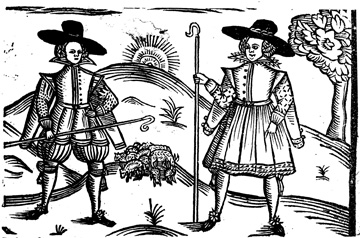
Although Shakespeare does not mention specific breeds of sheep, his contemporaries did. So important were sheep to people in the sixteenth and seventeenth centuries that poems and images conveyed to readers the centrality of this animal for English life and culture. In 1624, John Taylor published a pamphlet titled Taylors Pastorall: Being Both Historicall and Satyricall: Or the Noble Antiquities of Shepheards, with the Profitable Vse of Sheepe, a rather lengthy title, that clearly shows how central sheep were to sixteenth and seventeenth century culture. The image on the title page to Taylor’s work shows two happy shepherds in traditional seventeenth century clothing. In the background, the sheep are huddled together and occupy the center of the image. Taylor praises the nobility of sheep by noting all the parts of the animals’ production and uses, including their intestines to make musical instruments, their dung for fertilizer, their horns as antidotes to poison, and their leather, which makes “Purses, Powches, Laces, Strings, Gloues, Points, Booke-Couers, and ten thousand things.” And certainly, Shakespeare’s early life was spent making some of these thousands of things, which may be the reason why gloves appear so often in Shakespeare’s work. An arrogant solider in Shakespeare’s play Henry V wears a glove in his hat in order to challenge a foe that he had previously met. Williams, the solider, says “An’t please your majesty, a rascal that swaggered with me last night; who, if alive and ever dare to challenge this glove, I have sworn to take him a box o’ th’ ear: or if I can see my glove in his cap, which he swore, as he was a soldier, he would wear if alive, I will strike it out soundly” (4.7). The ridiculous solider carries around a familiar object in seventeenth century England, and those in Shakespeare’s audiences would have recognized the glove and associated it with the sheep from which it came, perhaps thinking in their minds of the Cotswold sheep or other heritage breeds.
Before Shakespeare’s day, the Anglo Saxons and their ancestors wrote of rare breeds, including the Exmoor pony. A Latin manuscript from 1085, known as The Domesday Book (or Doomsday), discusses the Exmoor pony, calling them “unbroken mares” (equae indomitae), and mentions at least 104 of them that were roaming the English countryside in the eleventh century. Another heritage breed that was developed during the Roman or the Anglo Saxon period was Ancient White Park cattle. White cattle were brought by the Romans to England in 43 AD. When the Romans evacuated the country in 410 AD, they set the breed free in the woodlands of medieval England. In 1225, King Henry III granted a charter giving the Baron Ferrers the right to once again enclose this breed in Chartley Park, which was completed in 1248. From this feral population, Ancient White Park cattle originated, and the Kings of England historically hunted these cattle for sport. Shakespeare might not only have seen this breed in enclosures and on farms, but perhaps even roaming in one of five large “deer parks.” [Ancient White Park cattle retain their wild temperament to this day.]
Shakespeare seems to have felt pity for inhumane butchering practices, for in Henry IV, Part II, he describes the death of a young calf in striking terms:
And as the butcher takes away the calf
And binds the wretch, and beats it when it strays,
Bearing it to the bloody slaughter-house,
Even so remorseless have they borne him hence (3.1)
These lines refer to the death of the character Gloucester, but the imagery recalls a scene that most of Shakespeare’s audience would have immediately recognized as familiar. The calf is bound and then beaten, and Shakespeare’s language here evokes the painful slaughtering that took place when a young calf (considered a delicacy then as it is now) was led to be butchered for a meal. But Shakespeare also expresses a more negative view of cattle, as when in his play As You Like It the disguised Rosalind (who is dressed as a man named Ganymede) criticizes people for changeable emotions, noting that “boys and women are for the most part cattle of this colour” (3.2), or fickle victims to quick changes in attitudes and feelings. In this case, young boys and women are compared to cattle, not because they are docile, but because they cannot control their emotions and waver between extremes in passion. Some of the cattle, such as the Ancient White Parks that Shakespeare may have seen, livestock that made him both pity and at the same time criticize their behaviors, would have been what we now recognize as heritage breeds.
Today, the Shakespeare Birth Trust, which is responsible for maintaining Shakespeare’s home in Stratford-upon-Avon, raises a herd of Cotswold sheep at Mary Arden’s farm. Mary Arden was Shakespeare’s mother, and Shakespeare may have heard stories of the behaviors and uses of these and other heritage breeds from his mother’s tales of her childhood. One can imagine Shakespeare also visiting his mother’s family farm to see these breeds in their enclosed pastures or even roaming the English countryside in certain areas that were not influenced by the controversial enclosure acts of the period. The Shakespeare Birth Trust website describes the background behind this heritage breed: “The Cotswold sheep have lustrous fleeces and were a very important wool breed in the Medieval and Tudor period” (www.shakespeare.org.uk). Today, visitors can see rare breeds on a Tudor farm that Shakespeare certainly knew quite well. We can guess that he also knew rare breeds before they were considered rare, for Shakespeare’s life was full of interactions with and references to cattle, sheep, goats, horses, ponies, and poultry. Shakespeare’s Hamlet describes humans as “the paragons of animals” (2.2), but he nonetheless recognized the importance of animals, particularly livestock, to sixteenth and seventeenth century society.
Katie Walker is a doctoral student in the University of North Carolina at Chapel Hill English and Comparative Literature Department, where she studies Shakespearean Drama. Katie’s research focuses on early modern medicine and the body. She is the wife of ALBC staff member Ryan Walker, whom she drags to many Shakespearean performances around the globe! Katie can be reached at [email protected].
| The American Livestock Breeds Conservancy | |
PO Box 477 |
ALBC is a trademark
of American Livestock Breeds Conservancy. |
Pittsboro, North Carolina 27312 USA |
|
Telephone: 919-542-5704 |
|
Fax: 919-545-0022 |
|
|
HOME About
ALBC Breed Information Calendar ALBC
Store |
|