"...when the last individual
of a race of living things breathes no more, another Heaven and another
Earth must pass before such a one can be again."
-William Beebe
 • SEARCH ALBC
This article appeared in the November/December 2010 issue of the ALBC newsletter. ALBC members receive 6 bi-monthly newsletters that contain articles about the breeds of livestock and poultry that we work to conserve as well as the people involved in these efforts. Members also receive an annual breeders directory that provides contact information for ALBC members who have breeding stock available, as well a list of products from these breeds that they offer for sale.
Please support our work, join today!
Swine Inbreeding Levels: Ramifications for Managing Genetic Diversity
By Harvey Blackburn and Carrie Welsh
This article summarizes the recent research study entitled Pedigree analysis of 5 swine breeds in the United States and the implications for genetic conservation published in the Journal of Animal Science in February 2010. The research shines light on several valuable lessons for rare breed stewards. 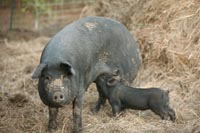 (Mulefoot photo by Hank Will)
In general there is a global contraction in genetic diversity at the breed and within breed levels. This loss is of concern to livestock breeders and animal geneticists because genetic variation is the raw material used for the production of future animal generations. Monitoring changes in genetic diversity for the purposes of conservation and management of genetic diversity can be done with various types of tools. One approach is to use molecular markers that require the collection, laboratory analysis, and computational analysis of the samples. An older approach is to use pedigree records from which a number of genetic diversity parameters can be calculated based upon computed genetic relationships between the animals. This method is considerably cheaper and faster than using DNA markers, but it requires breeders to have banded together in the formation of a breed society that maintains pedigree records.
Because there is a need to better understand levels of “within breed” genetic diversity, a study was performed to evaluate five major U.S. swine breeds. Fortunately, the National Swine Registry has maintained pedigree records on the breeds in an electronic format since the late 1970s. As a result, we were able to use these records to evaluate the status of genetic diversity for the Berkshire (n = 116,758), Duroc (n = 878,480), Hampshire (n = 744,270), Landrace (n = 126,566), and Yorkshire (n = 727,268) breeds. From the pedigree records, we were able to compute an average inbreeding level for each breed per generation, the change in inbreeding per generation, and the effective population size. While the breeds discussed in this article had a large number of records, such large numbers are not necessary to employ the methods discussed.
Figure 1 illustrates the progression of inbreeding from one generation to the next for all five breeds studied. It 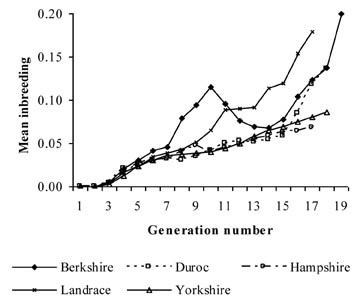 should be noted that the time interval between generations varied by breed, for example, the time between generations for Berkshire was 1.65 years while Yorkshire’s had a 2.21 year interval. (An animal’s generation number is determined by averaging the sire and dam’s generation number.) The graph illustrates that, as with any closed population, inbreeding will increase over time. Figure 1 also shows that inbreeding is increasing at relatively constant rates for the Yorkshire and Hampshire breeds, while the Berkshire, Landrace, and Duroc have increased at faster rates and had much higher average inbreeding levels. Importantly, we can see that in later generations the Berkshire and Landrace have reached inbreeding levels where inbreeding depression may start impacting performance.
An important measure of genetic diversity which can be calculated from the change in inbreeding from one generation to the next is effective population size. Effective population size is the number of randomly mated animals in a breed that yield the calculated rate of inbreeding. There is a general consensus that for populations to maintain sufficient genetic diversity effective population size should range from 50 to 100 animals. For the five breeds evaluated, effective population size ranged from 74 to 112 animals. When compared to the number of animals registered per year for these breeds this may be a surprisingly small number since, for example, Durocs registered over 12,000 animals in 2007. It should be noted that similar types of results have been observed for the Holstein breed which has an effective population size of 36 animals.
Up to this point in the discussion, only the genetic/biological aspects of genetic diversity in pig breeds have been discussed. However, breeders and their structure are the key element in determining how genetic diversity is developed, maintained, or lost. In our evaluation, we evaluated breeder dynamics including breeder location, longevity in registering pigs of a particular breed, and herd size. There was a tendency for breeders with greater longevity and those with larger herd sizes to have lower inbreeding levels, particularly with the Berkshire breed. This trend has been more pronounced when we have done similar evaluations for rare livestock breeds like the Navajo-Churro and Hog Island sheep. Breeder longevity also indicates that breeders that have remained in the business for a longer period of time are more responsible for the genetic diversity management of the breed.
There are several key points from this analysis which may be useful when considering the management of endangered livestock or poultry breeds. We can anticipate that inbreeding is increasing in these populations just like in the major swine breeds. However, we do not know how fast inbreeding is increasing. To answer this question a similar analysis would have to be performed for these breeds. For this to occur, there must be detailed pedigree records that extend over multiple generations. In the management of inbreeding two points are key:
1) Breeders have the ability to control increases in inbreeding by determining which boars and sows/gilts to mate to one another, as illustrated by the differences between the Yorkshire and Berkshire breeds.
2) Secondly, because breeders make mating decisions and emphasize different traits over time, inbreeding levels can be reduced, for a relatively short period of time, as animals that have a lower relationship to the population as a whole are used with greater frequency (differences in breeding objectives is good for genetic diversity). This point is illustrated by the dip in Berkshire inbreeding levels from generations 11 to 16 (Figure 1). During this time there was a shift of selection emphasis as Berkshire breeders developed a market in Japan.
The results also show that effective population size will most likely be smaller than the breed’s actual population size. Therefore, assessing breed genetic diversity or well-being by census numbers or registration numbers alone has important limitations: albeit census or registration numbers are relatively easy to acquire. The establishment of pedigree recording systems with the dedicated personnel to maintain such records can be a significant challenge. Fortunately for pigs, established organizations like the National Swine Registry are likely to partner and engage in this task with the owners of rare breeds.
In summary, all breeds numerically large or small face a similar set of issues when it comes to managing genetic diversity and controlling the accumulation of inbreeding. While inbreeding when practiced in excess can be detrimental to a population, it is also a useful tool for breeders to use to hold in place the selection progress that has been achieved over time. It is when breeders are not aware of their population’s inbreeding level that the risk of losing genetic diversity increases. Part of the solution is a comprehensive effort to record and maintain pedigrees and ideally performance information on individual animals, such efforts are technically feasible. But the primary element in the solution is for breeders utilize such information when making mating decisions.
Harvey Blackburn is an Animal Geneticist and the Coordinator of the National Animal Germplasm Program (NAGP). He manages the development and acquisition of animal germplasm at the NCGRP and he coordinates the six animal species committees that advise the NAGP about collection development. Blackburn may be emailed at [email protected]. The original research study was authored by C.S Welsh, T.S. Stewart, C. Schwab, and H.D. Blackburn. The study can be found in the Journal of Animal Science published in February 2010.
| The American Livestock Breeds Conservancy | |
PO Box 477 |
ALBC is a trademark
of American Livestock Breeds Conservancy. |
Pittsboro, North Carolina 27312 USA |
|
Telephone: 919-542-5704 |
|
Fax: 919-545-0022 |
|
|
HOME About
ALBC Breed Information Calendar ALBC
Store |
|