"...when the last individual
of a race of living things breathes no more, another Heaven and another
Earth must pass before such a one can be again."
-William Beebe
 • SEARCH ALBC
Droughts, Disasters, and Rare Breed Survival
By D.P. Sponenberg
The role of environmental catastrophes in breed development and breed survival is an important 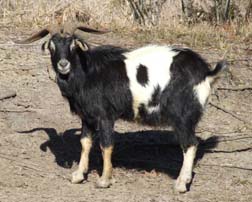 one. Different catastrophes have arisen several times during the last year, in different parts of the globe, and knowing how to tackle an environmental disaster can be important for breeders, and for the breeds they steward into the future.
Adapted landraces have all come to us through repeated temporary disasters, and in a very real sense the disasters are what shaped these breeds to be the tough survivors that they are. In that sense, the disasters are actually part and parcel of the whole selection environment, albeit one that must be used creatively and carefully by the breeders.
Stefan Adalsteinsson, now regretably deceased, was long a careful observer of Icelandic livestock. He referred to breeds, and especially landraces, as having “the genetic heritage of survival.” In the Icelandic case, this meant cattle whose ancestors had survived two very severe periods of cold, crummy weather over the centuries. The weak died, the strong survived, and the present Icelandic cattle go back to the genetic strength of those survivors. (For that matter, so do the Icelanders themselves.) While it is easy to look back and see this effect, it is sometimes more difficult to appreciate it during a contemporary disaster. Breeders should realize that present day hardships are frequently providing opportunities for selection, so that future generations can look back and see selection for rugged, productive stock.
It is important to understand how to use disaster so that the result is beneficial to the genetic structure of the animals and the breed. A recent trip to Argentina was in “el tiempo de la vaca flacca” (the season of the skinny cow) and the cows were skinny indeed! The region had had a prolonged drought, and was close to desert to begin with. Goats were surviving, but even among goats the reproduction rate was very low due to nutritionally-induced abortions around 60%. At those levels, production suffers and producers face really hard choices.
Tough years such as these provide producers with very good insight into which animals are best adapted, but that insight comes at a high cost. In the case of the Argentine farmers, the diminished production due to the drought meant that all (or nearly all) of the kids from those lean years needed to be sold for cash instead of retained for breeding. At first blush, this diminishes selection for adaptation, because no one is able to afford to hold on to these survivors. Coming up with strategies for farmer survival as well as breeding stock selection then come to the forefront. With good record keeping it is possible to identify the does that produced those surviving kids, and when good years roll around, the breeder can then preferentially keep kids from those does and not from the ones that failed in the harsh years. Even with poor record keeping, an earnotch in the non-producers can help the breeder keep track of which doe is doing what level of job.
Fortunately, even in this harsh year for parts of the United States, the word from the Spanish goat breeders in Texas is that the goats are faring all right, and breeders have been able to maintain their herds. These herds are an important resource, so events like prolonged drought could have a very massive negative effect very quickly. The Spanish goat brings to mind another issue of rare breed survival, and that is the intricacies of breed census and population structure. This breed has a census of around 7,000 or so animals, meticulously documented by Leslie Edmundson in her coordinating role for the Spanish Goat Association. This high number should seemingly remove the breed from a high level of concern, until it is realized that most of the population is held in a few herds of 1,000 to 1,500 head. An environmental disaster such as a drought can easily wipe out huge portions of the breed nearly overnight as breeders can be faced with few options but selling large numbers. Equally disastrous can be the untimely death of a breeder. In either case, a well-organized group of breeders can help to blunt the blow to the breed by assuring that animals are moved to new situations with new stewards so that years of selective breeding are not lost for future use.
 For adversity to shape breeds it must be allowed to act, but likewise the survival of the breed has to be assured. A disaster that kills the last remaining animals of any breed cannot be used to select the breed for the future, because the breed has ceased to have a future. This situation is especially likely when breeds have a limited geographic range, and it is important for breed stewards to consider this aspect when organizing breeders and their distribution. This need for reasonably wide distribution has to be weighed against breeds that function and are selected in a specific environment, because removing them for that environment (even if for well-meaning security of the population) also removes them from the selection pressures brought by that environment.
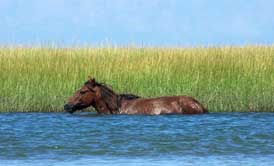
Hurricane Irene fortunately did not eliminate the Banker ponies in North Carolina, but that was a real risk. One of the mares was even able to foal during the hurricane – and to raise that foal successfully. This is a good example of an adapted breed surviving a recurring threat!
In contrast, a few genetic resources in Ethiopia and Somalia may well disappear in their drought because these breeds have dwindled over recent years and now they only occur in limited geographic ranges. If these breeds go extinct, the genes that worked well for centuries will also vanish. These breeds became rare during benign times due to crossbreeding, and then dwindled to extinction as numbers collapsed in the current severe drought. In this case, there will be nothing from which to rebuild these breeds, and this is a huge loss for future generations. Preventing such extinctions for our North American breeds needs to be a priority for all breeders, and this takes wise consideration of both the positive and the potential negative effects of disasters as they play out for both numerical and genetic strength of breeds. Success is always multifaceted, but one consistent component is diligent attention to the numerical strength of the breed and its distribution in order to assure that the chances of extinction through common disaster are reduced.
D. Phillip Sponenberg, DVM, Ph.D. is a Professor of Pathology and Genetics at Virginia Tech, in Blacksburg, Virginia. He is a long-time member of ALBC, and serves as a Technical Advisor to the ALBC staff. He can be reached via email at [email protected].
| The American Livestock Breeds Conservancy | |
PO Box 477 |
ALBC is a trademark
of American Livestock Breeds Conservancy. |
Pittsboro, North Carolina 27312 USA |
|
Telephone: 919-542-5704 |
|
Fax: 919-545-0022 |
|
|
HOME About
ALBC Breed Information Calendar ALBC
Store |
|